

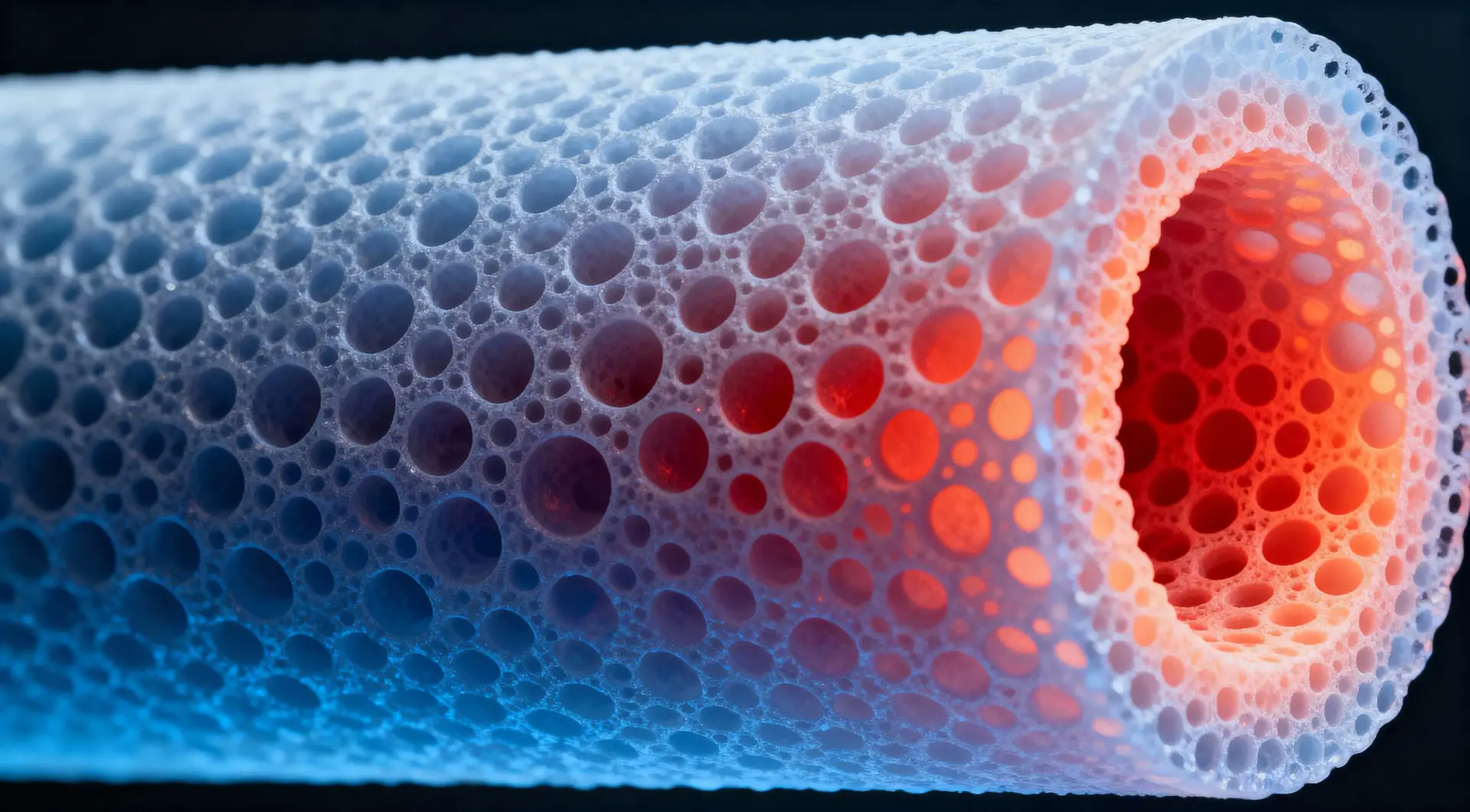
If you could weave winter into a thread, it might look like this. A new Nature Communications study introduces gradient all-nanostructured aramid aerogel fibers (GAFs)—ultra-light fibers that block heat better than air (yes, really) while staying surprisingly strong and flexible. Scientists pulled this off with a smart twist on fiber architecture: a nanoporous outer “sheath” and a roomier inner “core.” That gradient turns the fiber into a thermal maze for heat, while its nano-entangled network spreads out stress so the fiber doesn’t snap.
Let’s unpack what that means—for engineers and for the rest of us.
The simple picture: making heat take the long way around
Think of heat like a crowd trying to rush through a stadium. If all hallways are wide open, people flow quickly (high thermal conductivity). But if you keep changing hallway sizes and adding doorways between sections, the crowd slows. That’s what the gradient does. The outer layer with finer pores and the inner layer with bigger pores create interfaces that scatter and stall heat. As a result, radial heat flow drops dramatically.
For non-scientists
- Aerogel = frozen foam of nanoscopic pores. It’s mostly empty space, so heat and sound don’t travel easily.
- Gradient = pores that change size across the fiber’s radius. That change creates speed bumps for heat.
For science folks
- Coarse-grained MD shows the gradient density model develops a steeper temperature drop at the interface than a uniform model under the same ΔT, signaling higher interfacial thermal resistance.
- Simulated and measured trends align: GAFs ~0.0228 W·m⁻¹·K⁻¹, vs. wet-spun aerogel fibers (SAFs) around 0.0327 W·m⁻¹·K⁻¹.
Why this fiber doesn’t tear like tissue paper
Aerogels can be brittle, but these fibers aren’t. The nano-entangled network inside GAFs spreads local stress so cracks don’t race through. Compared to wet-spun SAFs with a stiff, thin “skin” that fails early, GAFs deform gracefully:
- Tensile strength: ~29.5 MPa (≈3× SAFs, ~10.9 MPa)
- Fracture strain: ~39.2% (vs. ~17.8% in SAFs)
- Toughness: ~5.7 MJ·m⁻³ (vs. ~1.06 MJ·m⁻³)
In Raman under strain, GAFs show the smallest redshift in the amide I band (~Δν ≈ 0.3 cm⁻¹), indicating lower internal stress distribution compared to Kevlar and SAFs.
The manufacturing trick: microfluidic spinning
Instead of classic wet spinning that accidentally makes a dense outer skin, the team intentionally engineers the gradient using:
- Shear alignment + diffusion dilution in a microfluidic chip (sheath DMSO angles into the ANF core).
- Acidic coagulation to lock in the gradient gel.
- Supercritical CO₂ drying to flip and refine pore structure—ending with ~150 nm pores outside and ~600 nm inside.
They can tune the gradient thickness (20–60%) by adjusting sheath flow (e.g., 500–1500 µL·min⁻¹). That’s real-time structural control, not an afterthought.
Numbers that turn heads
- Porosity: ~98.6% (vs. ~98% in SAFs)
- Density: ~15.7 kg·m⁻³ (lighter than SAFs at ~20.5 kg·m⁻³)
- Thermal conductivity (radial): 0.0228 W·m⁻¹·K⁻¹ (below air ~0.026)
- Mechanical: 29.5 MPa strength, 39.2% strain; 1,000 cycles at small strain with minimal degradation
- Durability: Stable in cold, heat, and vacuum—a big deal for aerospace.
Where it lands in the real world
- Personal thermal management: Winter jackets, gloves, boots—warmth without bulk.
- Firefighting & military gear: Light, flexible heat barriers that don’t crumble under stress.
- EVs and drones: Thermal sleeves around batteries and electronics without weight penalties.
- Buildings & vehicles: Thin, flexible wraps for thermal retrofits where space is tight.
- Aerospace: Lightweight, vacuum-tolerant insulation for space suits and instrument bays.
What’s next? (Speculative, but spicy)
- Hybrid radiative control: Add IR-selective fillers to tune emissivity while preserving the gradient’s conductive blockade.
- Directional composites: Weave GAFs into anisotropic textiles to guide heat sideways, not skin-in or skin-out.
- Smart sensing: Embed nanoscale thermistors or fiber Bragg gratings; let the insulation report hotspots before failure.
- Circularity: Explore greener solvents and re-aerogelation routes for end-of-life recycling.
Key takeaways (engineers’ edition)
- Mechanism: Interfacial thermal resistance from radial pore-size gradients suppresses radial kkk.
- Process: Microfluidic control of shear/diffusion-driven concentration gradients + supercritical drying yields a skin-to-core nanoporous inversion.
- Performance: kᵣ ~0.0228 W·m⁻¹·K⁻¹, σ ~29.5 MPa, εᶠ ~39.2%, ρ ~15.7 kg·m⁻³, φ ~98.6%.
- Tuning knob: Sheath-flow rate dictates gradient thickness and outer-layer porosity.
Check out the cool NewsWade YouTube video about this article!
Article derived from: Fu, X., Si, L., Zhang, Z. et al. Gradient all-nanostructured aerogel fibers for enhanced thermal insulation and mechanical properties. Nat Commun 16, 2357 (2025). https://doi.org/10.1038/s41467-025-57646-4