aerospace materials

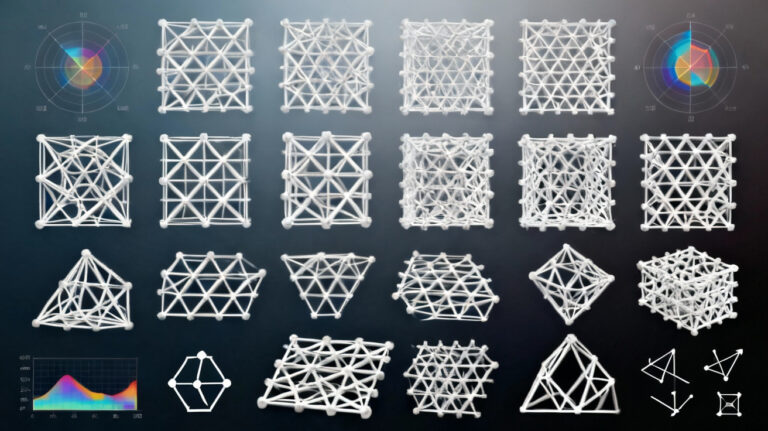
Array of diverse truss metamaterial unit cells with overlays of stiffness and Poisson’s ratio maps.

Mining Extreme Properties from 1.8 Million Truss Metamaterials — A Plain-English + Deep-Tech Guide

Engineers just mapped a huge new frontier in metamaterials. By encoding unit-cell architectures as graphs and tiling them with crystallography, researchers auto-generated 1.8 million truss designs and computed their effective elastic properties. The payoff is big: near-Voigt stiffness, Poisson’s ratios spanning extremely negative to very positive, and even isotropic bi-mode lattices that behave like liquids. Better yet, the team discovered mechanical isomerism, where tiny architectural tweaks transform properties by orders of magnitude—turning a routine lattice into a best-in-class design. This database doesn’t just predict performance; it closes long-standing “gaps” in stiffness and ν, enabling inverse design for aerospace panels, medical implants, acoustic cloaks, soft robots, and more. If you’ve wanted a tool that lets you ask for behavior and receive architectures that deliver it, this is the moment.

Read More...
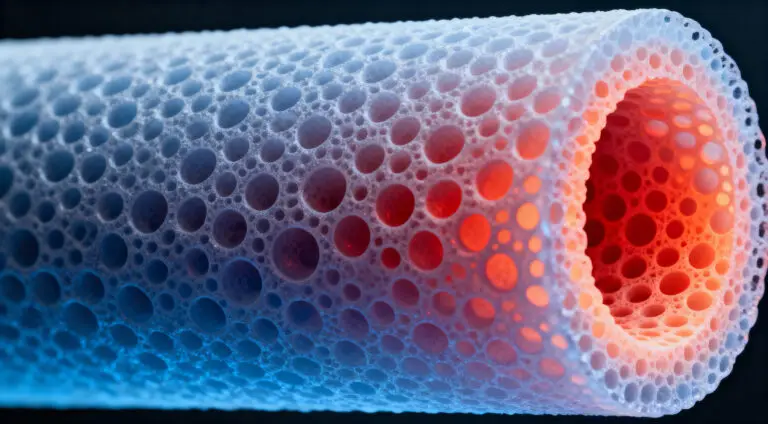
Cross-section of a gradient aramid aerogel fiber with fine pores outside and larger pores inside.

Gradient Aerogel Fibers: How a “Fluffy-Core, Fine-Skin” Design Crushes Heat and Stays Tough

A new class of gradient all-nanostructured aramid aerogel fibers (GAFs) delivers thermal insulation that beats air while staying light and tough. By engineering a radial pore gradient—fine pores outside (~150 nm), larger pores inside (~600 nm)—the fibers create interfacial thermal resistance that slows heat flow, dropping radial thermal conductivity to 0.0228 W·m⁻¹·K⁻¹. Unlike wet-spun fibers that form a stiff, failure-prone skin, GAFs weave a nano-entangled network that spreads stress, reaching ~29.5 MPa strength and ~39.2% strain. A microfluidic spinning process, followed by supercritical drying, lets researchers tune gradient thickness and pore structure on demand. The result is a scalable, fabric-ready fiber for personal thermal management, firefighting gear, EVs, and aerospace—anywhere you need thin, flexible, high-performance insulation. In short: the gradient turns heat into a maze and keeps the fiber unflappable under load.

Read More...
A futuristic shape-memory alloy bending and returning to its original form, with applications in space exploration, medical implants, and advanced vehicles in the background.

Revolutionary New Metal Could Change Space Exploration and Everyday Tech

Scientists have developed a revolutionary shape-memory alloy that is lightweight, ultra-strong, and superelastic, even in extreme cold. This breakthrough material, made from titanium, aluminum, and chromium (Ti-Al-Cr), could transform space exploration, medical implants, and advanced engineering. With the ability to bend and recover its shape across a wide temperature range, this alloy is set to redefine durability in deep space, high-tech devices, and everyday applications.

Read More...