
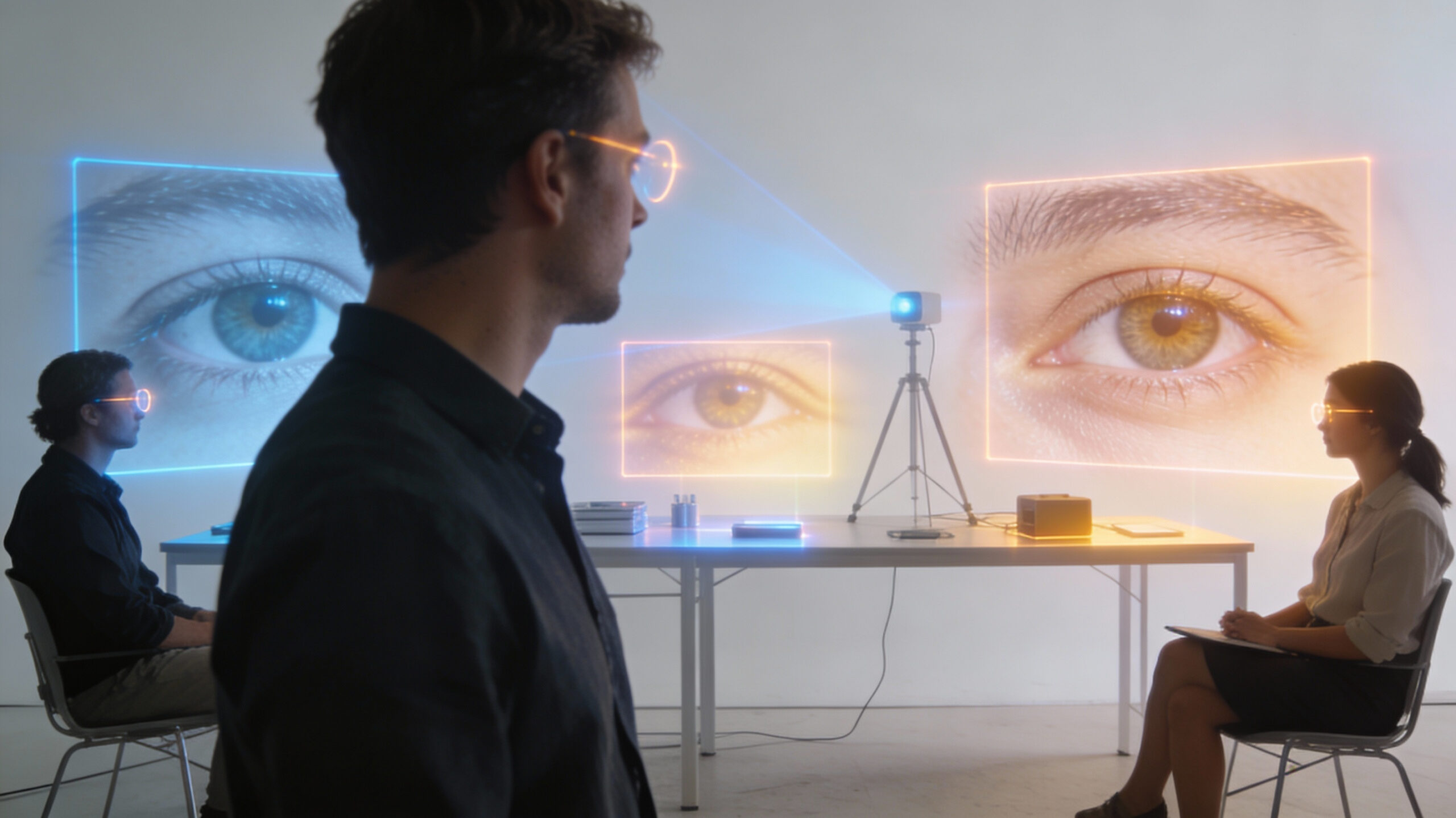
When you stare out a café window or scroll past a photo online, it feels effortless. Your eyes dart around without instructions. However, new research shows something surprising: your eyes are actively trying to understand what’s happening, not just chasing bright colors or flashy objects.
A 2025 study published in Nature Communications reveals that during “free viewing”—when we look at scenes without a task—our eye movements are driven by scene understanding, not visual salience. In other words, your eyes are asking: What matters here?
This finding reshapes decades of thinking in vision science and has big implications for AI, neuroscience, and even how we design images and interfaces.
The Old Idea: We Look at What Pops Out
For years, scientists believed eye movements were guided mainly by saliency—bright colors, sharp edges, or strong contrast. That idea made sense. After all, flashy things grab attention.
Later, researchers refined this with “meaning maps,” suggesting we look at regions people judge as meaningful.
But there was a problem.
In real life, what’s locally interesting isn’t always what explains the scene.
The New Discovery: We Look at What Explains the Scene
Researchers Shravan Murlidaran and Miguel P. Eckstein asked a deeper question:
What if our eyes are trying to understand the whole situation?
To test this, they created clever image pairs called Winograd images. Each pair looks nearly identical, but a tiny change—like swapping an object—completely changes the meaning of the scene.
Example:
- A man sitting on a couch
- Same image, but now he’s folding laundry
Visually similar. Meaningfully different.
Four Ways of Looking
Participants viewed these images under four conditions:
- Free viewing – just look naturally
- Describe the scene – explain what’s happening
- Search for an object – goal-driven
- Count objects – mechanical task
Here’s what stood out:
- Free viewing eye movements looked almost identical to scene-description eye movements
- Both were very different from search or counting
- Small changes that altered meaning caused big changes in where people looked
That alone hinted something deeper was going on.
Scene Understanding Maps (SUMs): A New Tool
The team introduced a powerful new idea: Scene Understanding Maps (SUMs).
Here’s how they work:
- Remove one object from an image
- Ask people to describe the scene
- Measure how much the description changes
If removing an object drastically changes the description, that object is critical to understanding the scene.
Result?
- During free viewing, people fixated most often on objects with the highest SUM scores
- Not the most colorful
- Not the most locally “meaningful”
- The most explanatory
Proof It’s Not Just Habit — It’s Functional
To test causality, the researchers ran a bold experiment.
Participants were forced to fixate on:
- Either a scene-critical object
- Or a scene-irrelevant object
They then had to describe the scene.
The outcome was striking:
- Fixating on critical objects led to significantly more accurate descriptions
- Fixating elsewhere reduced understanding
This shows eye movements don’t just reflect understanding — they actively create it.
Why We Look at People So Much
Ever notice how your eyes jump to people first?
This study explains why.
When people were removed from images, scene descriptions changed more than with any object removal. Humans are often the most informative elements in a scene.
So our brains prioritize them—because they explain intent, action, and context.
Why This Matters (A Lot)
This research changes how we think about vision:
- Neuroscience: Eye movements are part of active reasoning, not passive sensing
- AI & Robotics: Vision systems should prioritize understanding, not just saliency
- UX & Design: What users look at reflects meaning, not just aesthetics
- Education & Media: Visual storytelling works when critical elements guide the eye
In short, vision is cognition in motion.
The Big Takeaway
When you look at the world with no instructions, your brain defaults to one powerful goal:
Understand what’s going on.
Your eyes are not wandering.
They’re investigating.
Check out the cool NewsWade YouTube video about this article!
Article derived from: Murlidaran, S., & Eckstein, M. P. (2025). Human eye movements during free viewing are driven by scene understanding. Nature Communications, 16, Article 7673. https://doi.org/10.1038/s41467-025-67673-w