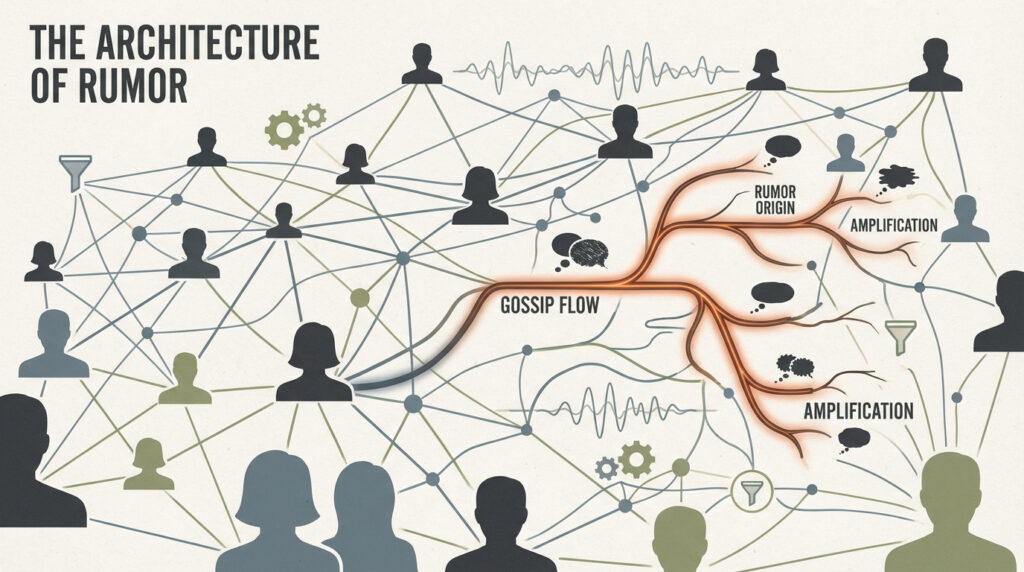


Gossip feels effortless. Someone leans in, lowers their voice, and a story begins to spread. Yet researchers at Brown University just revealed that the simple act of gossiping is powered by surprisingly sophisticated mental calculations. According to their new study in Nature Human Behaviour, the human brain is constantly running a complex internal algorithm that helps us spread information strategically while avoiding social fallout.
This discovery shows that gossip is not just idle chatter. Instead, it relies on deep cognitive processes that help us navigate our social networks with remarkable precision.
The Hidden Logic Behind Who We Gossip To
Brown’s research team, led by Associate Professor Oriel FeldmanHall and Ph.D. student Alice Xia, found that two main variables guide our gossip decisions:
1. Popularity – How many direct social connections the listener has
2. Social distance – How close the listener is to the target of the gossip
People instinctively avoid gossiping with someone who is closely connected to the subject. On the other hand, they are more willing to share information with someone who is popular but not directly linked to the target. This creates what the researchers call a “winning algorithm” for gossip that spreads information widely without immediately alerting the person being discussed.
Even more fascinating, the brain performs these calculations automatically. We rarely pause to think through the implications, yet the underlying process is mathematically complex.
Cognitive Mapping: How the Brain Tracks Social Networks
This kind of decision-making depends on something called a cognitive map—a mental blueprint of social relationships. FeldmanHall’s earlier research showed that humans replay social interactions during sleep, quietly constructing an internal model of who knows whom.
Although most of us cannot consciously diagram our social networks, our brains rely on these internal maps to predict:
- Who will share information
- Who the gossip might eventually reach
- How fast the story will travel
This ability appears to be both instinctive and incredibly efficient.
How the Study Worked
To test these ideas, researchers first taught participants a fictional nine-person social network. Then they asked participants to choose who they would likely gossip to and who they would avoid. Even in this simple scenario, people relied on popularity and social distance.
Next, the team scaled up the experiment using real first-year Brown University students living in residence halls. They mapped friendships across this much more complicated network and tested 100 students on how they thought information would spread. Despite the thousands of possible connection paths, students could still accurately predict gossip flow.
The researchers then partnered with neuroscientist Matt Nassar to build a computational model showing how the brain simulates gossip transmission. When we see Mary hanging out with James and James spending time with Adam, our brain compresses those observations into a simplified structure that helps us forecast who will hear what news—even several steps away.
Why These Findings Matter
This research challenges the idea that gossip is trivial. In reality, the human brain devotes significant processing power to the task. It also explains why gossip plays such a strong role in social bonding, reputation management, and group dynamics.
The study even offers insight into social media. Platforms like TikTok, Instagram, and X use algorithms that mirror human gossip behavior by promoting content through users with high influence and distant network connections.
As FeldmanHall put it, “The fact that our brains invest this much mental math in keeping our gossip out of the wrong hands is testament to the power of gossip and the sophistication of the human brain.”
This work was supported by the National Science Foundation (Grant 2123469).
Check out the cool NewsWade YouTube video about this article!
Article derived from: Brown University researchers discover how people gossip without getting caught. (2025, July 1). Brown University. https://www.brown.edu/news/2025-07-01/gossip-network