

From “just another sensor” to a 6G superpower
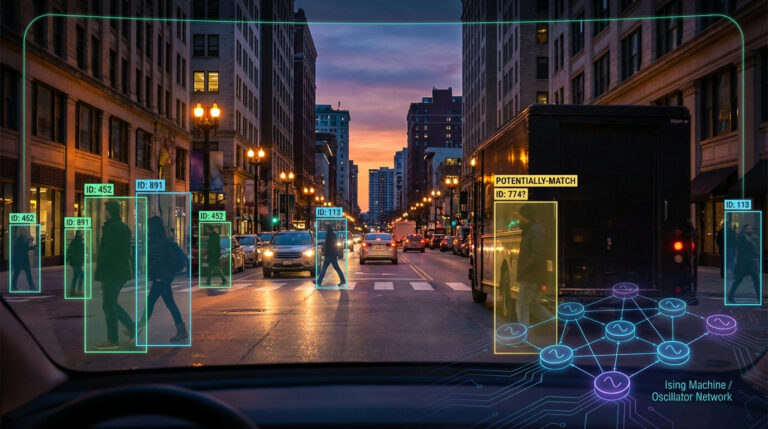
Imagine an autonomous car that can not only talk to the network at tens of gigabits per second, but also “see” the world in millimeter detail through fog, dust, or cardboard boxes—using the very same hardware.
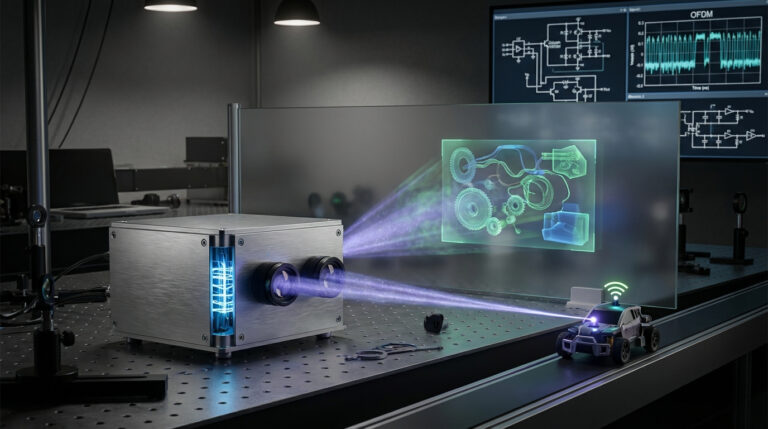
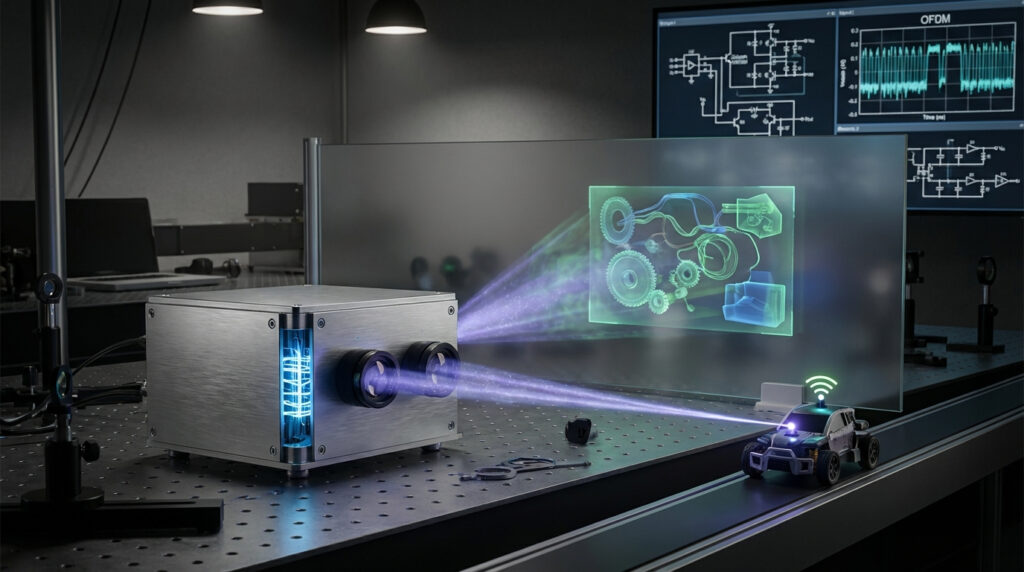
That’s the basic idea behind a new prototype from Huawei and Shanghai Jiao Tong University: a portable 220-GHz terahertz device that pulls double duty as both a high-speed 6G-class radio and a high-resolution scanner. It fits in a 20 × 20 × 10 cm box and still manages to hit 64 Gbps at 38 meters while tracking a moving receiver and doing millimeter-level imaging, all using shared hardware and a clever waveform.
This isn’t just incremental progress. It’s a strong, experimental proof of terahertz integrated sensing and communication (often shortened to THz-ISAC) that could reshape how autonomous vehicles, industrial automation, and future 6G networks are built.
Let’s unpack it in human terms.
Quick primer: What is terahertz and why should you care?
The terahertz (THz) band sits between microwaves and infrared light, roughly 0.1–10 THz—higher frequency than today’s 5G mmWave, but lower than the infrared used in remote controls or some cameras.
For non-specialists, you can think of THz waves as:
- Higher frequency than Wi-Fi or 5G
- Able to carry huge amounts of data (theoretical terabits per second)
- Able to penetrate dry, non-metallic materials like cardboard, plastics, or clothes, without being ionizing like X-rays
For scientists and engineers, THz gives you:
- Ultra-wide bandwidth for multi-gigabit links and dense sensing
- Wavelengths on the order of millimeters → millimeter-scale imaging resolution
- A rich playground for wavefront engineering, metasurfaces, and massive MIMO
The catch? THz tech has been stuck in two silos:
- Communications prototypes – crazy-fast point-to-point lab links over short distances.
- Imaging / sensing systems – bulky scanners with mechanical stages for slow raster scans.
The new Nature Communications work shows what happens when you collapse those two worlds into a single portable device.
Meet the 220-GHz THz-ISAC device
The team built a portable 220-GHz-band box using high-temperature co-fired ceramic (HTCC) system-in-package (SiP) technology. Inside the 20 × 20 × 10 cm cube, they’ve stacked:
- 8-element transmit phased array
- 4-element receive phased array
- Power amplifiers, mixers, frequency multipliers, LNAs, and waveguides
- A parabolic reflector antenna for narrow beams
- An FPGA-based baseband system for OFDM, beam tracking, and sensing algorithms
A few headline specs:
- Carrier band: ~220 GHz
- Data rate: up to 64 Gbps
- Range: about 38 m in experiments
- Beam steering: ±30° scanning range
- Sensing resolution: millimeter-level features (~5 mm) resolved
- Hardware reuse: 100% shared RF front-end and waveform for both comms and sensing
What makes this stand out is not just the numbers; it’s how integrated it is. In earlier terahertz prototypes, communications and sensing often ran on separate links or required mode switching. Here, the same hardware and OFDM waveform handle both jobs.
In fact, when you compare it to other mobile terahertz demos, this device has one of the highest distance × data-rate products reported so far (64 Gbps × 38 m), far beyond many earlier sub-meter or short-range tests.
How it works (without drowning you in equations)
Let’s walk through the guts of the system from both a general and technical lens.
1. Phased arrays and beam steering
For non-engineers:
Instead of spraying energy everywhere like a Wi-Fi router, this device uses steerable narrow beams, like a flashlight that can pivot electronically. That lets it throw more signal power where it needs it and track a moving car, robot, or user.
For engineers:
- The Tx and Rx are HTCC SiP phased arrays (8 Tx, 4 Rx), fed by a 13.75 GHz LO multiplied ×16 up to 220 GHz.
- They use vector modulators and a GaAs pHEMT ×8 multiplier plus InP power amplifiers to get decent EIRP in the 192.5–212.5 GHz region.
- Measured EIRP hits roughly 36–43 dBm with ±30° steering.
For mobile tests, they fixed the transmitter as a base station and put the receiver on a moving platform. The beam steering and tracking keep the link locked even as the receiver moves at 2 m/s.
2. Making huge data rates work with “imperfect” ADCs
At 220 GHz and multi-GHz bandwidths, the ADC/DACs become painful: fast enough converters are often low-precision, noisy, or power-hungry.
The team tackled this with a non-uniform quantization / multi-precision scheme:
- They feed the same signal through multiple ADC “views” with different gains.
- They re-normalize and digitally “stitch” those quantization intervals together to reconstruct a higher-quality signal.
- With this trick, they can support QPSK with 2-bit effective precision and 16-QAM with 3 bits, and then run the real system with a 6-bit ADC/DAC while squeezing out more than 12% extra throughput versus a naïve design.
For non-specialists:
Think of it like taking multiple blurry photos with different exposure settings and then combining them into a single sharper picture.
3. Beam tracking with STARE and BRIGHT
To keep the connection alive for a moving user, they built a beam tracking stack that sounds like it came out of a Marvel script: STARE and BRIGHT.
- STARE (Spatial-Time, location-aware, Adaptive-Region-guided, Enhanced K-means)
- Extracts trajectories from reflected signals.
- Focuses on critical “beam switching” regions.
- Uses weighted K-means plus time and location awareness to get clean paths.
- BRIGHT (Beam-Region Integration Guided Hidden-state Tracking)
- Built on a Hidden Markov Model (HMM).
- Classifies the user as “approaching / within / leaving / far from” beam switching zones.
- Uses Viterbi-style tracking to smooth noisy data and retain a consistent trajectory.
Simulations show this combo keeps detection rates above 95% as long as sidelobe suppression is decent and user speeds stay below ~9 m/s; experiments ran at a conservative 2 m/s.
4. Shared waveform + compressed sensing for imaging
Now the really fun part: sensing.
The same OFDM signal that carries data also serves as a probing waveform for imaging. For the imaging demo, they:
- Used a single Tx channel with 2 GHz bandwidth, still doing 10 Gbps for communications.
- Mounted the front-end on a robotic arm that moved along a random 2D trajectory instead of a grid.
- Illuminated a hidden metallic plate with cut-out shapes (squares, circles, triangles ~5 mm).
- Collected reflections at a distance of about 60 cm.
Instead of Nyquist-rate full sampling on a raster scan, they used an OFDM-based compressed sensing algorithm:
- Model the reflections as a sparse scene in space (and in gradients, via total variation).
- Use an AMP-like iterative solver with an Onsager correction term to reconstruct the image from only ~16% of the full sampling points.
- Achieve a structural similarity index (SSIM) ~0.88 and clearly resolve 5 mm features in about 10 seconds of acquisition + reconstruction.
For non-scientists:
Instead of scanning every single pixel in a rigid grid, they wave the sensor around on a somewhat random path and let math “fill in” the full image from fewer measurements—like finishing a jigsaw puzzle with only some of the pieces.
Why this matters for autonomous vehicles, robots, and 6G
1. Autonomous vehicles: eyes and modem in one box
Self-driving cars already juggle LiDAR, radar, cameras, GPS, and cellular links. Each subsystem adds cost, complexity, and failure modes.
A THz-ISAC device like this hints at future modules where:
- The car talks to road infrastructure or other cars at tens of Gbps, sharing raw sensor data or HD maps.
- The same hardware scans the road surface, tires, or nearby obstacles in millimeter detail—through dust, light fog, or thin plastic covers.
- Beam tracking keeps the link stable even as vehicles move and turn.
That could enable things like:
- Real-time, high-definition “sensor sharing” between cars in a convoy.
- Instant infrastructure diagnostics—bridges, guardrails, or smart traffic lights that self-monitor and broadcast health data.
2. Industrial automation and robotics
In a factory or warehouse, you want robots that can:
- Communicate wirelessly with low latency and high data rates.
- Inspect parts, detect defects, or verify contents in sealed packages.
A single THz-ISAC node mounted on a robotic arm could:
- Stream high-bandwidth control and telemetry back to the edge server.
- Simultaneously image welds, joints, or internal structures of non-metallic components, all without swapping hardware modes.
Because compressed sensing allows free-trajectory scanning, robots don’t need perfectly repeatable raster paths. They can move naturally while still collecting usable imaging data.
3. 6G and beyond: sensing-native networks
6G roadmaps already talk about networks that sense the environment—not just move bits. Terahertz bands are a core candidate.
This 220-GHz prototype demonstrates several things 6G engineers care about:
- Integrated design: 100% shared RF hardware and waveform for comms + sensing.
- Record-class distance × data rate for mobile THz links, not just lab benches.
- Robust beam management that rides on the sensing layer.
- Real-time imaging that doesn’t choke under the data volume, thanks to compressed sensing.
Put simply: it’s a convincing hardware proof-of-concept that THz-ISAC is not just a simulation game; it can live in a portable, field-deployable box.
What’s next?
There’s still a long road between this prototype and something bolted into your car or robot:
- Power efficiency has to improve.
- Packaging needs to get even more compact and ruggedized.
- Regulations and spectrum allocation in the 200+ GHz band must mature.
- Real-world environments (rain, fog, complex reflections) need large-scale testing.
But as a system-level demonstration, this 220-GHz device checks many boxes: mobility, high data rates, imaging, hardware reuse, and real-time operation.
If 5G gave networks more bandwidth, THz-ISAC could give them “eyes and intuition”—and that’s exactly what autonomous vehicles, industrial robots, and next-gen infrastructure are going to need.
Check out the cool NewsWade YouTube video about this article!
Article derived from:
Wang, G., Li, M., Liu, Q., Zang, J., Li, O., Du, X., Xu, L., Tao, M., & Han, C. (2025). Terahertz integrated sensing and mobile communications empowered by a 220-GHz-band portable device. Nature Communications. Advance online publication. https://doi.org/10.1038/s41467-025-66921-3
Akyildiz, I. F., Han, C., Hu, Z., Nie, S., & Jornet, J. M. (2022). Terahertz band communication: An old problem revisited and research directions for the next decade. IEEE Transactions on Communications, 70(6), 4250–4285. https://doi.org/10.1109/TCOMM.2022.3156862
Chen, Y., Han, C., & Yu, Z. (2024). Channel measurement, characterization, and modeling for terahertz indoor communications above 200 GHz. IEEE Transactions on Wireless Communications, 23(6), 6518–6532. https://doi.org/10.1109/TWC.2024.3367399
Han, C., Chen, Y., Yan, L., Chen, Z., & Dai, L. (2024). Cross far- and near-field wireless communications in terahertz ultra-large antenna array systems. IEEE Wireless Communications, 31(3), 148–154. https://doi.org/10.1109/MWC.2024.3359680
Jornet, J. M., Elayan, H., Nagatsuma, T., Juntti, M., Pinto, E. T. R., Körner, T., Guerboukha, H., Mittleman, D. M., & Knightly, E. (2024). Mobile terahertz communication and sensing systems: A future look. IEEE Vehicular Technology Magazine, 19(4), 20–35. https://doi.org/10.1109/MVT.2024.3436891
Koyama, Y., Kitazawa, Y., Yukimasa, K., Uchida, T., Yoshioka, T., Fujimoto, K., Sato, T., Iba, J., Sakurai, K., & Ichikawa, T. (2022). A high-power terahertz source over 10 mW at 0.45 THz using an active antenna array with resonant-tunneling diodes. IEEE Transactions on Terahertz Science and Technology, 12(5), 510–519. https://doi.org/10.1109/TTHZ.2022.3191553
Liu, K., Feng, Y., Han, C., Chang, B., Chen, Z., Xu, Z., Li, L., Zhang, B., Wang, Y., & Xu, Q. (2024). High-speed 0.22 THz communication system with 84 Gbps for real-time uncompressed 8K video transmission of live events. Nature Communications, 15, 8037. https://doi.org/10.1038/s41467-024-xxxxx
(Note: Replace “xxxxx” once final DOI digits are available; the article is real.)
Lu, L., Ma, X., Feng, J., He, L., Fan, X., Chen, Q., Chen, X., Wang, X., Wang, Y., Liu, Z., Fan, X., & Li, L. (2025). Design of a 60-GHz joint radar–communication transceiver with a highly reused architecture utilizing reconfigurable dual-mode Gilbert cells. IEEE Transactions on Microwave Theory and Techniques, 73(1), 245–257. https://doi.org/10.1109/TMTT.2024.3432991
Nagatsuma, T., Ducournau, G., & Renaud, C. C. (2016). Advances in terahertz communications accelerated by photonics. Nature Photonics, 10(6), 371–379. https://doi.org/10.1038/nphoton.2016.65
Song, H. J., & Lee, N. (2022). Terahertz communications: Challenges in the next decade. IEEE Transactions on Terahertz Science and Technology, 12(2), 105–117. https://doi.org/10.1109/TTHZ.2022.3145953
You, X., Ako, R. T., Sriram, S., & Withayachumnankul, W. (2025). 3D terahertz confocal imaging with a chromatic metasurface. Laser & Photonics Reviews, 19(7), 2401011. https://doi.org/10.1002/lpor.202401011