
Nature Communications

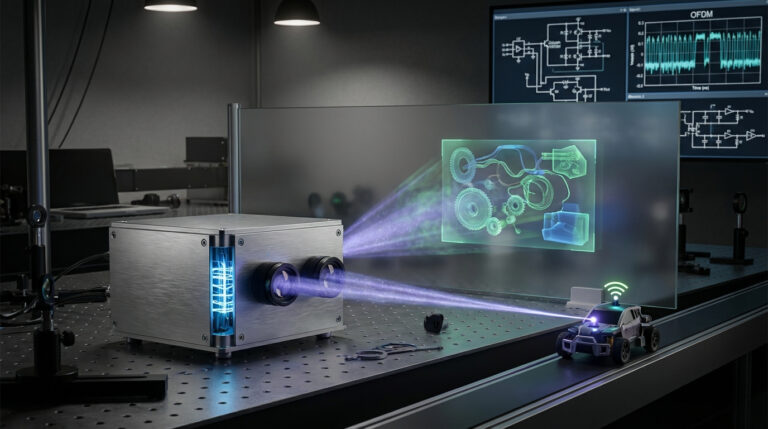
Compact 220-GHz terahertz device simultaneously connecting to a car and imaging hidden objects.

How a 220-GHz Terahertz Gadget Could Power Autonomous Cars, Industrial Robots, and 6G Networks

A new 220-GHz terahertz prototype from Huawei and Shanghai Jiao Tong University crams a 64-Gbps wireless link and millimeter-resolution imaging into a 20×20×10 cm box. By reusing the same hardware and waveform for both sensing and communication, it points toward 6G networks where autonomous cars, robots, and infrastructure share data and “see” the world with the same terahertz eyes.

Read More...
World map showing a network of industries as economies shift from agriculture to manufacturing and advanced technology, illustrating economic structural change.

Economies don’t just “grow” — they learn. They change what they’re good at, one step at a time.

Economies don’t just grow; they learn. A new Nature Communications paper builds a dynamic model where countries expand into industries related to what they already do, then shows that this simple rule explains decades of global structural change — and quietly reinterprets popular economic complexity metrics like ECI and Fitness as summaries of long-run development paths, not magic measures of hidden capabilities.

Read More...
Two exciton-polariton condensates on a photonic-crystal grating showing interference fringes and a propagation cone.

Hyperbolic Polaritons: Steering Quantum Fluids with Geometry

Researchers steered how two quantum light-matter fluids talk—by simply rotating them on a photonic-crystal waveguide. The hyperbolic dispersion lets coupling morph smoothly from evanescent to ballistic, revealing tunable gaps, interference fringes, and directed flow. It’s a geometric dial for analogue optical computing and next-gen quantum-inspired simulators.

Read More...