
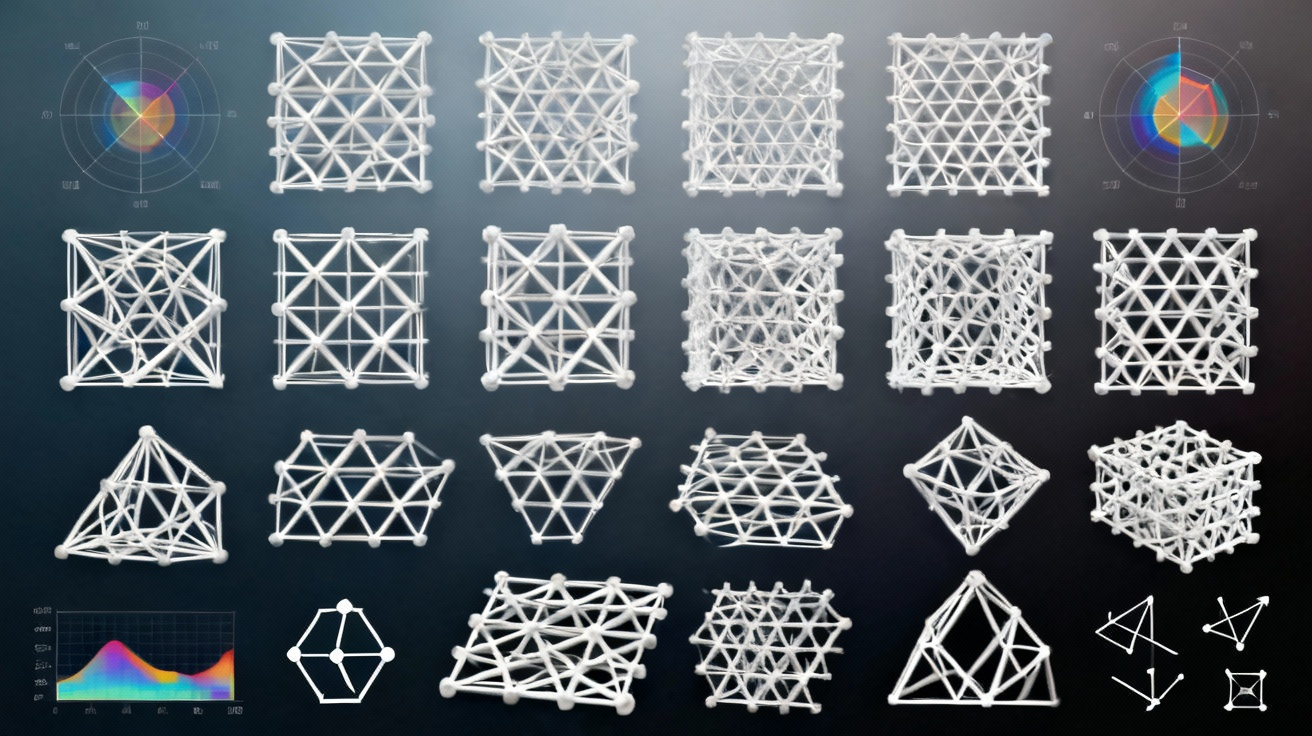
A research team encoded truss architectures like graphs, then auto-generated a database of 1,846,182 2D metamaterials. By sweeping this vast design space, they found ultra-stiff lattices near the Voigt bound, programmable Poisson’s ratios from very negative to very positive, and even rare “bi-mode” designs that behave like liquids (Poisson ≈ 0.5, near-zero shear). They also introduced mechanical isomerism—tiny architectural tweaks that flip properties by orders of magnitude.
Why this matters (for everyone)
If you’ve ever seen a honeycomb cardboard that’s light and strong, you’ve met a primitive metamaterial. Now scale that idea up: spacecraft panels that save fuel, shoes that protect joints, stents that flex in one direction but not the other, or acoustic cloaks that bend sound around an object. To build those, engineers need a map from architecture → property. This paper gives them a whole atlas, not just a few landmarks.
What did the team actually do?
- Encode architectures as graphs. Nodes (connection points) and struts (links) become a compact “DNA” for a unit cell.
- Leverage crystallography. They use plane groups (translation, rotation, reflection, glide) to tile a representative volume element (RVE) into a full lattice.
- Compute properties at scale. They homogenize each design to extract Young’s moduli (Ex, Ey), Poisson’s ratios (νxy, νyx), shear modulus (G), and an anisotropy index.
- Span a massive search space. Result: 1,846,182 unique truss metamaterials with consistent density (ρ̄ = 0.01) so stiffness comparisons are fair.
Plain-English explainer: core ideas you’ll see
- Voigt bound: Think of it as the “ceiling” for stiffness given a material’s density. Getting close means your architecture channels loads almost perfectly.
- Poisson’s ratio (ν): Pull a strip; if it narrows, ν is positive. If it widens, ν is negative (auxetic). Most bulk materials sit between −1 and +0.5 when isotropic.
- Anisotropy vs. isotropy: Anisotropic lattices act differently along x vs. y (like wood). Isotropic lattices act the same in all directions (like a pool of water).
- Bi-mode: Poisson ≈ 0.5 and near-zero shear—mechanically “liquid-like” but still a solid lattice. That’s gold for cloaking and vibration control.
Key scientific wins (for the technical crowd)
- Near-Voigt stiffness: 2,939 newly found designs push Ex/Ey toward the Voigt upper limit at ρ̄ = 0.01—often via stretching-dominated load paths (e.g., reinforced diamonds, axis-aligned struts that form many stiff triangles).
- Wild Poisson’s ratios: By favoring low-symmetry building blocks, they extend the reachable ν space to about −65 to +70 (reciprocal νxy·νyx respects stability: 0 < νxy·νyx < 1).
- Anisotropy control: Groups pm and pg reach extreme anisotropy; cmm boosts shear modulus through double-centered reflections, decoupling shear resistance from the sign of ν.
- Isotropic bi-mode: Four square-cell families (not just hex-honeycomb derivatives) achieve near-zero G and ν ≈ 0.5, including one (pmm_3044_4Eq_8Strut_8092) that pairs bi-mode with high isotropic stiffness (rare and useful).
- Mechanical isomerism (new concept): Keep the “skeleton” but nudge an inside node or a strut connection, and properties jump by orders of magnitude—even flipping ν from −55 to +19. This shows micro-architecture subtleties dominate outcomes.
How it works (non-science and science together)
- Non-science: Imagine LEGO® tiles you can repeat forever. Move a peg a few millimeters or add a brace, and suddenly your tiled floor gets way stiffer—or squishier sideways when you pull it. Now, automate those tweaks and test nearly two million patterns.
- Science: Use a graph-encoded unit cell, tile it via plane groups into an RVE, apply relative displacement boundary conditions, and compute the effective elastic tensor (beam elements, normalized by base Es). Sweep architecture variables and map the feasible property space.
Why it’s cool (and what changes now)
- It crushes the “data cascade” problem: instead of a tiny, biased sample of designs, we finally get coverage across “gaps” in modulus and ν.
- It gives ready-to-use lattices that already sit on the trade-off bounds (e.g., stiffness vs. ν extremes).
- It enables data-driven inverse design (ask for a target Ex/Ey, ν range, G, ASU → fetch near-optimal architectures).
Where could this go next?
- Aerospace & space: load-bearing shells, stiff-but-light connectors, adaptive morphing skins that avoid buckling.
- Medical devices: anisotropic lattices for bone-like implants; stents that expand without over-squeezing tissue.
- Acoustics & cloaking: bi-mode designs to steer sound or dampen shear in thin panels and metasurfaces.
- Robotics & wearables: lattices that are soft in one direction but supportive in another, improving comfort and endurance.
- 3D & manufacturing: extend the framework to 3D trusses, address feature size, sharp corners, and residual stress for AM-ready parts.
For builders: quick design heuristics
- Want near-Voigt stiffness? Favor stretching-dominated paths: long-diagonal diamonds with reinforced struts, and axis-aligned members that triangulate loads.
- Want extreme ν? Lower building-block symmetry (avoid rotation centers and reflection axes), then deploy non-p4 transformations at the RVE level.
- Want high G? Use double-centered reflections (group cmm); avoid single reflection or glide only.
- Hunting bi-mode? Search p4g and pmm families for ASU ≤ 10⁻³, ν → 0.5, G → 0—the paper shows square-cell routes, not just hex variants.
What’s next for non-experts
- Think of this as a recipe app for materials. You enter “crispy outside, chewy inside” (say, stiff in x, flexible in y), and the database suggests recipes (architectures) that bake those traits into the lattice—no exotic ingredients required.
Check out the cool NewsWade YouTube video about this article!
Article derived from: Chen, J., Wei, Z., Xiao, X. et al. Mining extreme properties from a large metamaterial database. Nat Commun 16, 9648 (2025). https://doi.org/10.1038/s41467-025-64745-9