Mining Extreme Properties from 1.8 Million Truss Metamaterials — A Plain-English + Deep-Tech Guide
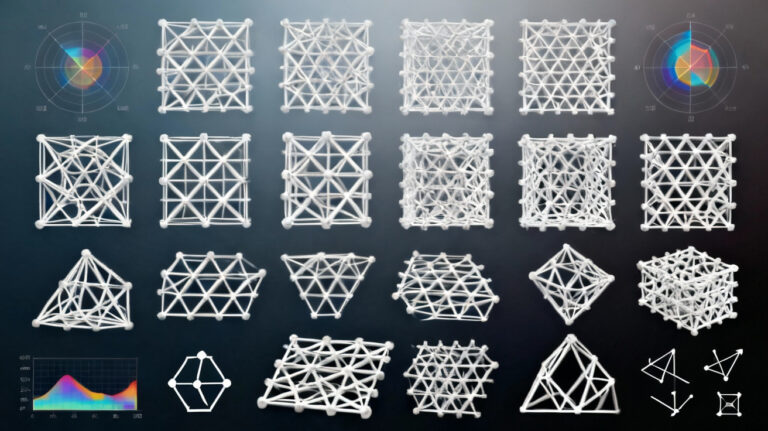
Engineers just mapped a huge new frontier in metamaterials. By encoding unit-cell architectures as graphs and tiling them with crystallography, researchers auto-generated 1.8 million truss designs and computed their effective elastic properties. The payoff is big: near-Voigt stiffness, Poisson’s ratios spanning extremely negative to very positive, and even isotropic bi-mode lattices that behave like liquids. Better yet, the team discovered mechanical isomerism, where tiny architectural tweaks transform properties by orders of magnitude—turning a routine lattice into a best-in-class design. This database doesn’t just predict performance; it closes long-standing “gaps” in stiffness and ν, enabling inverse design for aerospace panels, medical implants, acoustic cloaks, soft robots, and more. If you’ve wanted a tool that lets you ask for behavior and receive architectures that deliver it, this is the moment.