Materials Science

Experimental heavy-lift drone carrying a large payload during a DARPA test flight.

DARPA’s Lift Challenge: The $6.5M Heavy-Lift Drone Race That Could Reshape Vertical Flight

DARPA has launched the $6.5M Lift Challenge to reinvent vertical lift aviation. Teams must design lightweight drones capable of lifting more than four times their weight across a 5-nautical-mile course. This competition encourages universities, startups, and garage inventors to push drone engineering far beyond today’s limitations—potentially transforming military operations, logistics, and disaster response.

Read More...
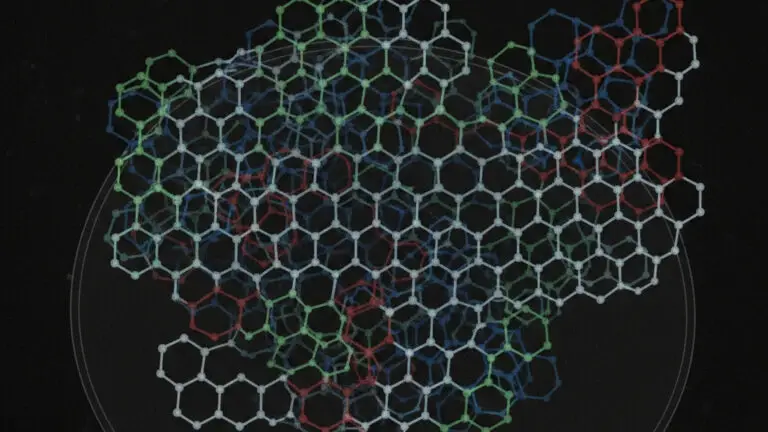
Rock-salt high-entropy oxide crystal showing multicolored cations influenced by temperature and oxygen chemical potential.

Thermodynamics-Inspired High-Entropy Oxide Synthesis: How Oxygen Became the Missing Design Knob

Researchers have revealed that oxygen chemical potential is the missing ingredient in high-entropy oxide synthesis. By lowering oxygen levels during high-temperature firing, they created seven new Mn/Fe-based rock-salt HEOs and introduced a powerful new predictor—oxygen chemical potential overlap—that transforms ceramic discovery into a guided thermodynamic process.

Read More...
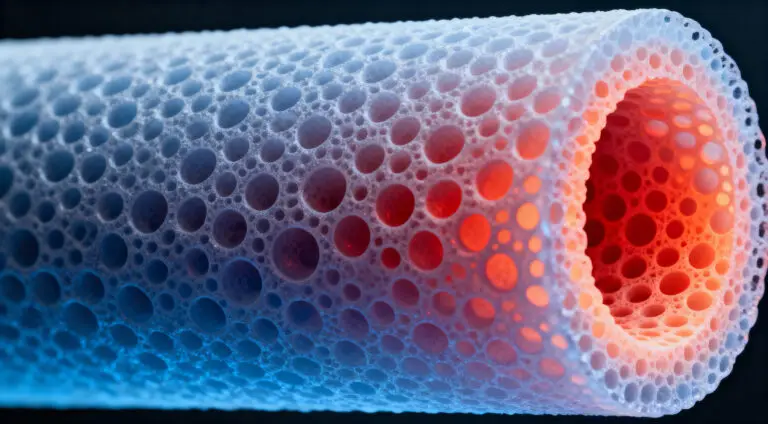
Cross-section of a gradient aramid aerogel fiber with fine pores outside and larger pores inside.

Gradient Aerogel Fibers: How a “Fluffy-Core, Fine-Skin” Design Crushes Heat and Stays Tough

A new class of gradient all-nanostructured aramid aerogel fibers (GAFs) delivers thermal insulation that beats air while staying light and tough. By engineering a radial pore gradient—fine pores outside (~150 nm), larger pores inside (~600 nm)—the fibers create interfacial thermal resistance that slows heat flow, dropping radial thermal conductivity to 0.0228 W·m⁻¹·K⁻¹. Unlike wet-spun fibers that form a stiff, failure-prone skin, GAFs weave a nano-entangled network that spreads stress, reaching ~29.5 MPa strength and ~39.2% strain. A microfluidic spinning process, followed by supercritical drying, lets researchers tune gradient thickness and pore structure on demand. The result is a scalable, fabric-ready fiber for personal thermal management, firefighting gear, EVs, and aerospace—anywhere you need thin, flexible, high-performance insulation. In short: the gradient turns heat into a maze and keeps the fiber unflappable under load.


Read More...