nanotechnology

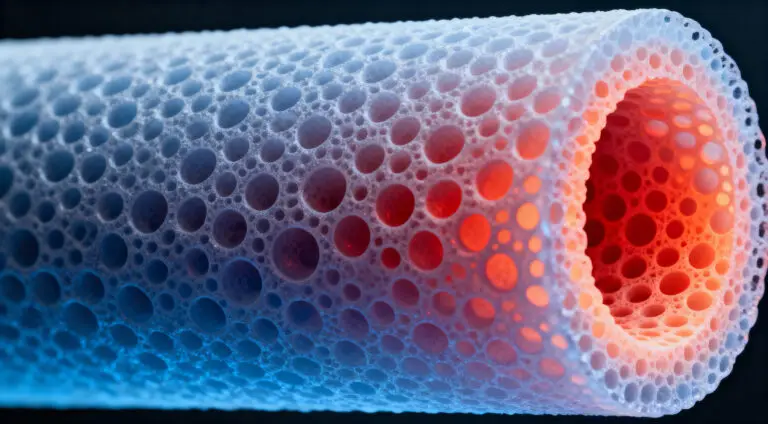
Cross-section of a gradient aramid aerogel fiber with fine pores outside and larger pores inside.

Gradient Aerogel Fibers: How a “Fluffy-Core, Fine-Skin” Design Crushes Heat and Stays Tough

A new class of gradient all-nanostructured aramid aerogel fibers (GAFs) delivers thermal insulation that beats air while staying light and tough. By engineering a radial pore gradient—fine pores outside (~150 nm), larger pores inside (~600 nm)—the fibers create interfacial thermal resistance that slows heat flow, dropping radial thermal conductivity to 0.0228 W·m⁻¹·K⁻¹. Unlike wet-spun fibers that form a stiff, failure-prone skin, GAFs weave a nano-entangled network that spreads stress, reaching ~29.5 MPa strength and ~39.2% strain. A microfluidic spinning process, followed by supercritical drying, lets researchers tune gradient thickness and pore structure on demand. The result is a scalable, fabric-ready fiber for personal thermal management, firefighting gear, EVs, and aerospace—anywhere you need thin, flexible, high-performance insulation. In short: the gradient turns heat into a maze and keeps the fiber unflappable under load.


Read More...
Futuristic microscope with glowing quantum particles and waveforms, magnifying nanoscale cellular structures in vibrant blue and neon green hues

Quantum Sensing and Microscopy: Revolutionizing Precision and Imaging

Quantum sensing and microscopy are revolutionizing science by harnessing the principles of quantum mechanics to achieve unparalleled precision in measurement and imaging. From nanoscale biomedical imaging to breakthroughs in materials science, these cutting-edge technologies are unlocking new possibilities in research and innovation

Read More...
Illustration of a scientist using van der Waals anvils to compress metals into ultrathin layers in a high-tech laboratory

Revolutionizing Material Science: The vdW Squeezing Technique

In a groundbreaking achievement, researchers have pioneered the vdW squeezing technique, enabling the creation of atomically thin two-dimensional metals. This innovative method involves compressing metals between van der Waals anvils under high pressure, resulting in layers as thin as a few angstroms. The potential applications are vast, from enhancing electrical conductivity in high-speed transistors to advancing quantum computing and optoelectronics. As scientists continue to explore its possibilities, vdW squeezing is poised to transform fields from electronics to quantum technology

Read More...

Breakthrough in Nanotechnology: A New Way to Create Gold Nanoparticle Arrays for Sensors and Electronics

Scientists have developed a cost-effective and scalable method to create highly ordered gold nanoparticle arrays, revolutionizing applications in sensors, electronics, and medical technology. Using anodic aluminum oxide (AAO) templates and a solid-state dewetting process, this breakthrough technique allows precise control over nanoparticle size and spacing, enhancing plasmonic properties for next-generation innovations

Read More...
Futuristic terahertz (THz) sensor emitting soft blue and purple waves, scanning an object in a high-tech security or medical imaging setting

Breakthrough in Terahertz Technology: New 2D Material Boosts Ultra-Fast Sensors

A groundbreaking discovery in terahertz (THz) technology is set to revolutionize high-speed sensing, medical imaging, and wireless communication. Scientists have developed a next-generation THz detector using a special 2D material, NbFeTe₂ (NFT), that enhances detection speed, sensitivity, and energy efficiency—without the need for extreme cooling. This innovation paves the way for faster airport security scans, advanced medical diagnostics, and ultra-fast wireless networks. Learn how this breakthrough in antiferromagnetic semimetals is shaping the future of sensing technology!

Read More...