
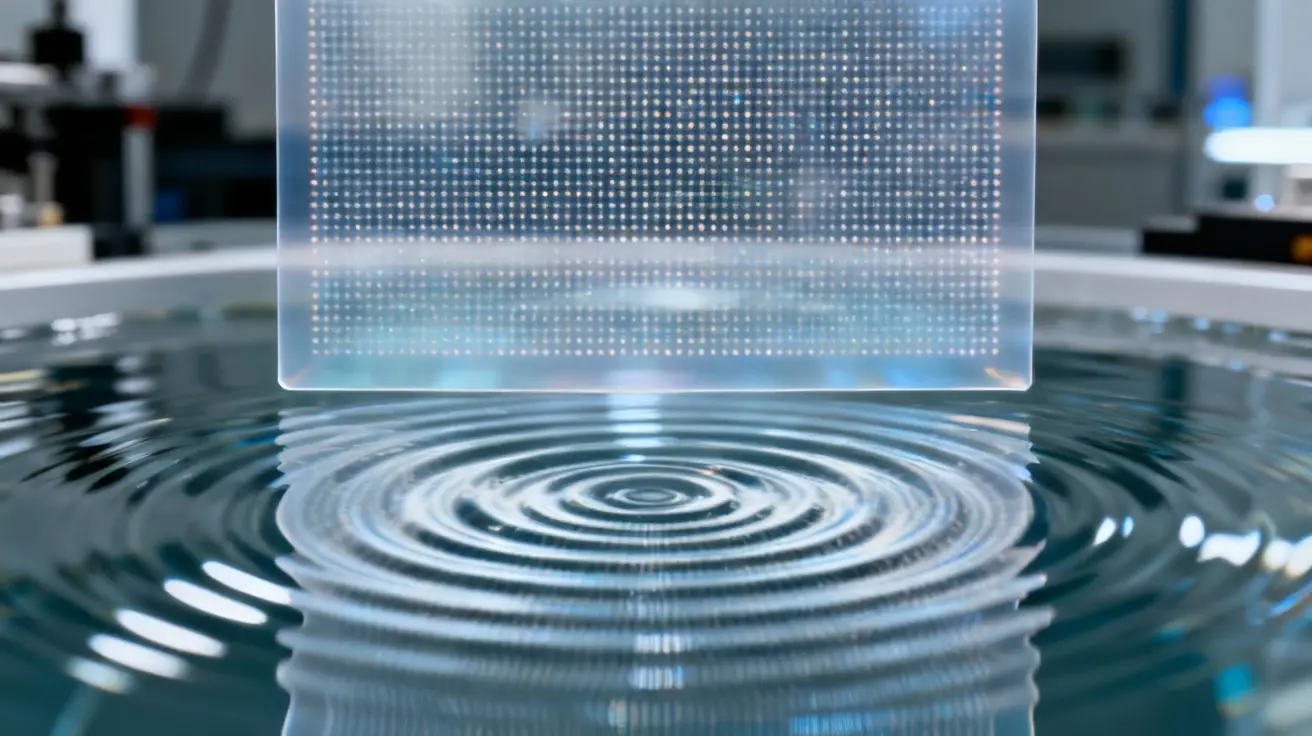
If you could paint with sound, what would you draw—cells herded into patterns, heat “written” behind tissue, or a tiny bird flapping in ripples on water? A new lab system shows how to do exactly that. Researchers built an acoustically transparent, rewritable metamaterial that sculpts ultrasound into high-resolution, fast-changing images—essentially dynamic acoustic holograms. It packs 10,000 pixels per cm² and refreshes at 50,000 frames per second, a leap that turns sound into a real-time display medium.
The simple version (for the rest of us)
Think of a Lite-Brite for ultrasound. A thin, special plastic sheet acts like a smart stencil. A laser “draws” patterns inside the sheet that bend sound just the right way to create pictures—rings, digits, even a flying bird—made purely of pressure. Pair the sheet with a tiny grid of ultrasound “speakers,” and you can flip scenes rapidly—like a movie made of sound. Because sound penetrates where light struggles, you can steer force or heat remotely, even through soft tissue.
The deeper dive (for science folks)
- Metamaterial: a crosslinked semi-crystalline PCL film doped with a photothermal dye. A 1064-nm laser locally melts micro-regions to lower sound speed (≈1880 m/s crystalline → ≈1520 m/s amorphous), encoding a binary ~π phase delay at 2.25 MHz with a 1.75-mm film.
- Transparency without big losses: Despite its multiphase nature, the film maintains >83% transmittance in both states, aided by gradient amorphous–crystalline interfaces that reduce reflections.
- Rewrite behavior: Due to crystallization hysteresis, locally melted zones persist long enough for rapid rewriting; a full erase–write for a brand-new map takes about 13 minutes if you let the film fully recrystallize.
- Actuation & multiplexing: An 8×8 partitioned PZT array (binary ON/OFF per element) controls amplitude, while the film sets phase. A DL-assisted IASA algorithm co-optimizes the PZT switch matrix and the film’s phase map. The team visualized fields via water-surface ripple imaging and demonstrated 50,000 fps switching (limited by surface recovery).
Why this matters
- Energy-lean control: Phase modulation preserves acoustic energy better than amplitude masks, enabling stronger effects at the target.
- Speed + resolution together: High refresh rates usually crush resolution. Here, you get both—ideal for acoustic tweezers, micro-assembly, microfluidics, and neuromodulation.
- Through-barrier operation: The system can write heat paths through tissue and trap particles in dark or opaque environments—beyond the reach of optics.
What they showed
- Programmable phase plates: Rewritable holograms formed rings, characters, and animated bird frames in water.
- Acoustic tweezing: By changing the hologram, pressure nodes moved and herded PDMS microparticles into different patterns on command.
- Remote thermal writing: After passing through 10 mm of tissue, the focused field heated a thermochromic target along a scripted path, sketching a “Z” in real time.
Practical notes & limitations
- Update latency for new maps: Full laser re-patterning is minutes-scale. However, once you have a merged pattern, PZT switching gives microsecond-to-millisecond scene changes.
- Packaging challenge: The current laser scanner is bulky. Materials that support projected structured light or resistive heating could shrink the system and speed patterning.
Where this could go next
- Biomed: Targeted sonodynamic therapy, focused hyperthermia, and deep-brain ultrasound with finer spatial control.
- Manufacturing & robotics: Micro-assembly, acoustic 3D printing, and reconfigurable beamforming for inspection and soft manipulation.
- Haptics & UX: Mid-air or through-surface haptic pixels that refresh fast enough to feel continuous.
Key specs at a glance
- Material: Crosslinked PCL + photothermal dye
- Frequency (demo): 2.25 MHz
- Phase modulation: Binary ~π (crystalline vs. melted)
- Resolution: ~100 µm / 10,000 px/cm²
- Refresh: Up to 50,000 fps via PZT switching
- Transmittance: >83% in both states
- Full rewrite time (new map): ~13 min
Check out the cool NewsWade YouTube video about this article!
Derived from: Zhang, M., Jin, B., Hua, Y. et al. Reconfigurable dynamic acoustic holography with acoustically transparent and programmable metamaterial. Nat Commun 16, 9126 (2025). https://doi.org/10.1038/s41467-025-64154-y