
Today’s fastest links, radars, and test tools all depend on crisp, high-speed electrical waveforms. However, pure electronics now struggle to keep scaling. Even premium digital-to-analog converters usually top out near 60–75 GHz, and pushing beyond that adds loss, heat, and packaging headaches.
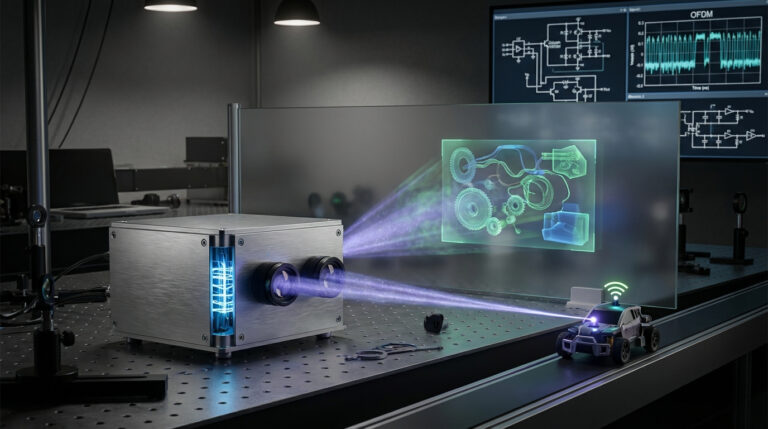
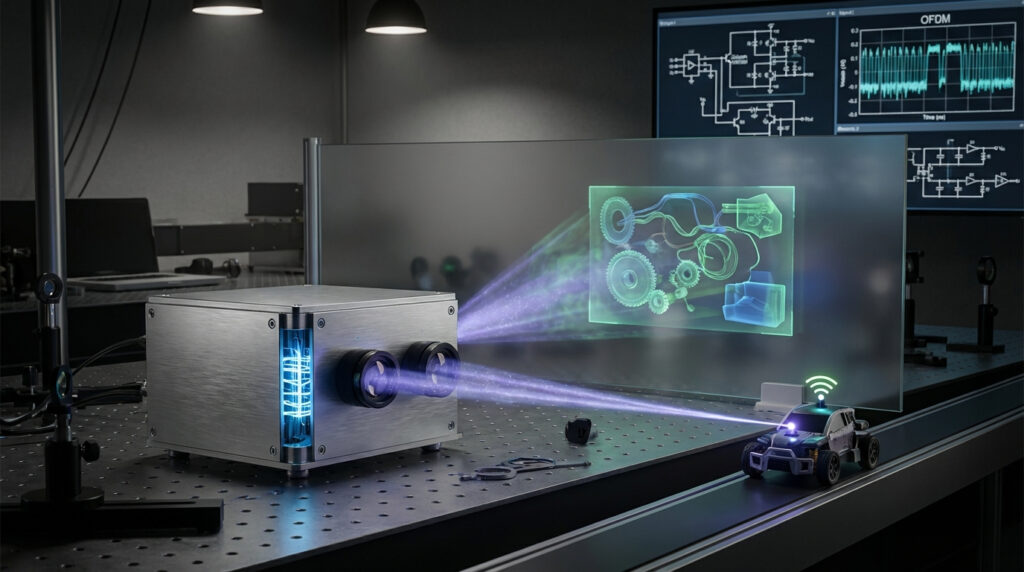
Enter a new path. Researchers built a photonic-electronic arbitrary waveform generator (PE-AWG) that shifts part of the job into optics. As a result, the system doubles effective bandwidth and reaches symbol rates up to 200 GBd—while keeping signal quality competitive with top bench units.
Why electronics hit a wall
First, traces and connectors start to sap power. Next, tiny timing errors pile up. Finally, complex RF mixers and multiplexers become hard to build and tune. Together, these issues slow progress.
How the PE-AWG works
Instead of forcing everything through RF, the team uses light to expand headroom.
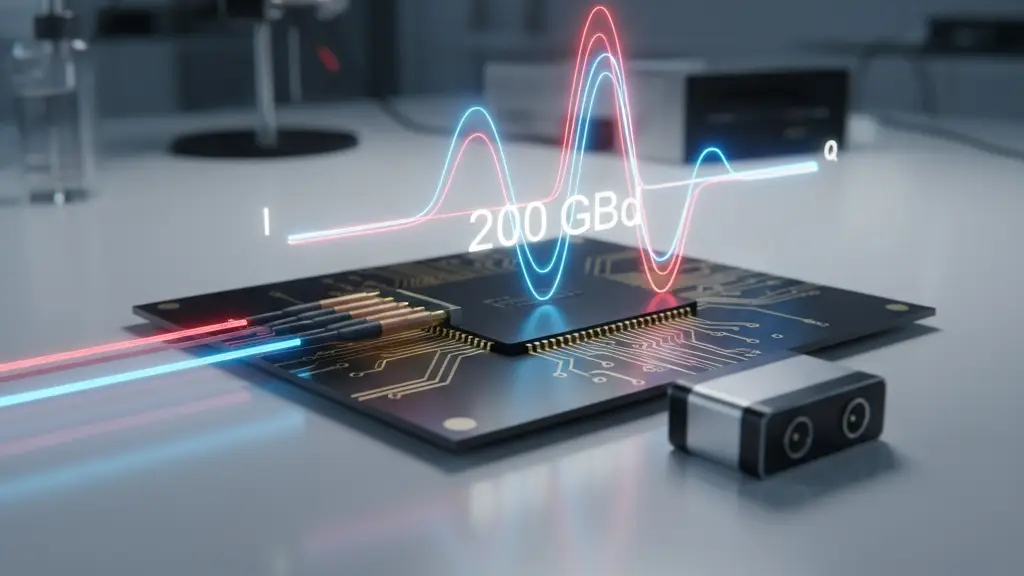
- Quadrature multiplexing (I/Q): Two synchronized drive signals modulate an optical carrier. Consequently, the optical signal spans twice the DAC bandwidth.
- Active phase lock: A feedback loop holds the phase steady. Therefore, the down-converted signal stays clean over time.
- Coherent down-conversion: A balanced photodetector mixes the optical waveform with a local laser tone and, in turn, produces a very wide electrical waveform.
Put simply: two ~50 GHz DAC channels in the optical domain behave like a 100 GHz electrical source—without stacking exotic RF silicon.
What they achieved
In tests, the PE-AWG produced PAM2/PAM4/PAM8 signals up to 200 GBd. Moreover, the team drove a Mach-Zehnder modulator and sent data over 10.5 km of fiber, while keeping error rates within forward-error-correction limits. Even better, signal-to-noise-and-distortion (SNDR) numbers match several high-end electronic generators.
Why it matters
Because optics carry huge bandwidth with low loss, this approach scales more gracefully. As integration improves, designers can stitch spectra from many optical slices, push well past 100 GHz, and still keep hardware simple at the output—often just one balanced photodiode and one amplifier. Consequently, labs could finally have waveform sources that outrun modern oscilloscopes.
What’s next
Soon, photonic chips should shrink the setup, cut cable loss, and reduce skew between paths. Likewise, better modulators and detectors can lift quality further. In short, photonics plus electronics offers a direct route to faster links, clearer radar, and stronger test gear—without waiting on ever-smaller CMOS nodes.
Check out the cool NewsWade YouTube video about this article!
Source: Füllner, C., Sherifaj, A., Henauer, T. et al. Photonic-electronic arbitrary-waveform generation using quadrature multiplexing and active optical-phase stabilization. Nat Commun 16, 8318 (2025). https://doi.org/10.1038/s41467-025-61564-w