
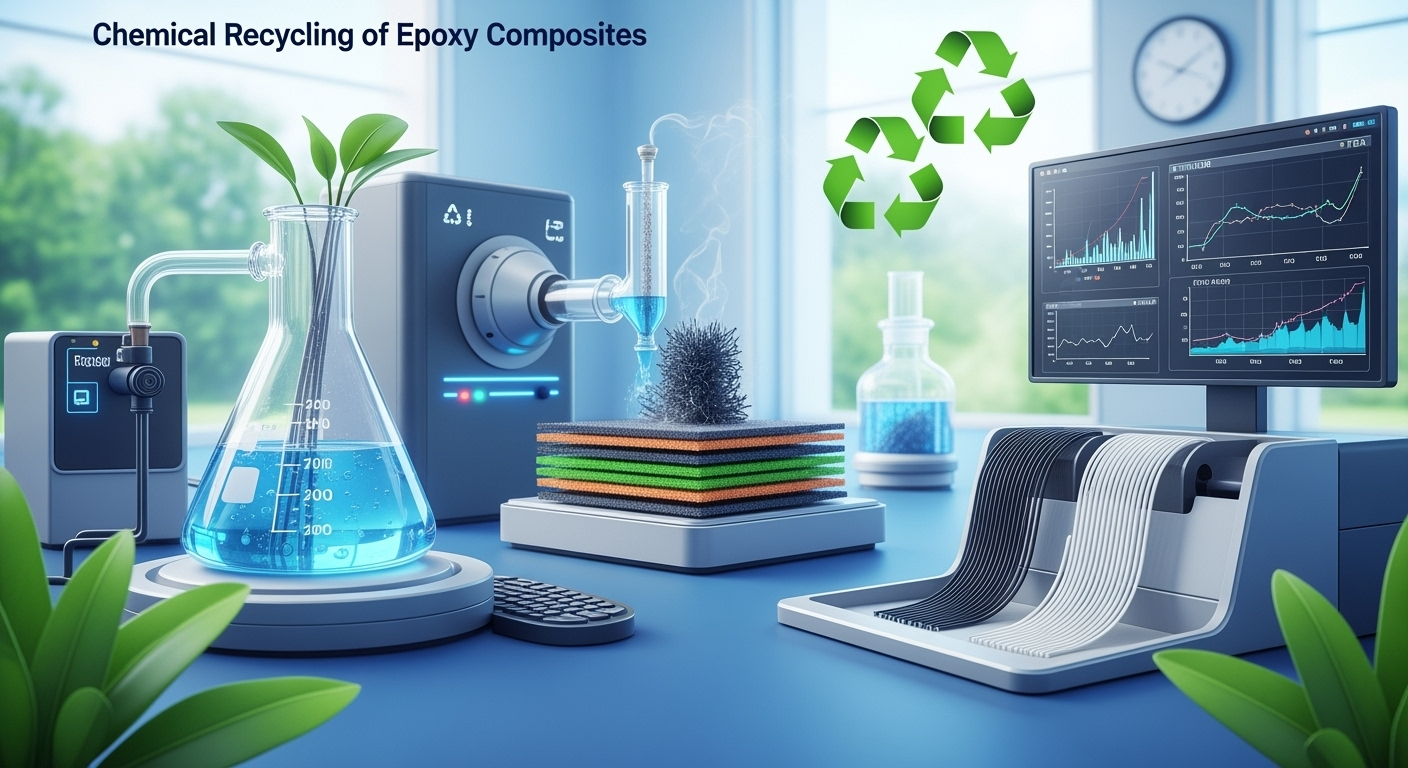
The Future of Composite Recycling Starts Now
Carbon fiber-reinforced composites (CFRCs) play a vital role in industries like aerospace, automotive, and wind energy. However, their durability creates a major environmental challenge. Once cured, thermoset resins become impossible to melt or reshape, which makes them difficult to recycle.
A team of researchers in Italy has tackled this challenge head-on. They developed a low-temperature, catalyst-free chemical recycling method that recovers both carbon fibers and epoxy resin oligomers. Unlike conventional methods, their process uses mild conditions and eco-friendly solvents—offering a practical path to sustainability.
Why This Breakthrough Matters
For years, recycling CFRCs involved high temperatures, extreme pressure, and toxic solvents. These traditional methods not only consumed vast amounts of energy but also produced harmful byproducts.
This new study, published in Polymers (2025), introduces a cleaner and scalable approach. Instead of destroying the entire polymer network, the researchers targeted specific C–N bonds using a simple solution of acetic acid and hydrogen peroxide. As a result, they preserved valuable resin components and cleanly separated the carbon fibers for reuse.
Inside the Process: Mild Conditions, Strong Results
The researchers selected a 36% bio-based epoxy resin paired with a phenol-free hardener. This combination already reduced the composite’s environmental footprint.
They used vacuum-assisted resin infusion (VARI) to create the composite panels, which ensured high-quality bonding between fibers and resin. After that, they treated the samples in a 95:5 mixture of acetic acid and hydrogen peroxide at three different temperatures: 70 °C, 80 °C, and 90 °C. Notably, 90 °C matches the resin’s glass transition temperature (Tg).
At this optimal temperature, they achieved a depolymerization yield of 81.3%. This meant the resin broke down into reusable oligomers, while the carbon fibers emerged nearly as clean as new.
Powerful Tools Confirm the Science
To verify the success of their method, the team used a variety of advanced tools:
- FT-IR and NMR spectroscopy confirmed that the epoxy resin’s backbone remained intact, indicating a selective C–N bond break.
- Thermogravimetric analysis (TGA) allowed them to quantify exactly how much resin had been removed.
- Scanning Electron Microscopy (SEM) and Energy-Dispersive X-ray Spectroscopy (EDS) revealed that the surface of the recycled fibers matched virgin fibers in purity and structure.
- Electrical testing showed that the fibers recycled at 90 °C had a conductivity of 8.04 × 10² S/m—remarkably close to the 2.20 × 10³ S/m of new fibers.
Through these tools, the researchers demonstrated that their recycled materials could match the quality of their original counterparts.
What Makes This Method Different?
This new chemical recycling approach offers a set of distinct advantages:
- It uses safe, biodegradable solvents and avoids harsh chemicals.
- It operates under 100 °C, reducing overall energy usage.
- It doesn’t require metal-based catalysts, lowering costs and simplifying scale-up.
- It enables the recovery of both carbon fibers and epoxy oligomers in a single step.
- It works with composites manufactured using existing VARI processes.
This combination of features makes the process both eco-friendly and industrially viable.
Toward a Circular Economy for Composites
This innovation doesn’t just solve a lab-scale problem—it opens a path to industrial-scale, sustainable composite recycling. For sectors like aviation, automotive, and marine manufacturing, the ability to recover both fiber and resin could transform waste management.
By aligning with circular economy principles, this approach reduces landfill waste, saves raw materials, and cuts emissions. Moreover, it positions manufacturers to meet growing environmental regulations and public demand for greener practices.
Ultimately, this technique proves that performance and sustainability can go hand in hand—setting the stage for a new era of responsible composite production.
Check out the cool NewsWade YouTube video about this article!
Article derived from: Guadagno, L., Longo, R., Raimondo, M., Vertuccio, L., Aliberti, F., Bonadies, L., Morciano, S., Longo, L., Pantani, R., & Calabrese, E. (2025). Chemical Recycling of Bio-Based Thermosetting Epoxy Composite Produced by Vacuum-Assisted Resin Infusion Process. Polymers, 17(9), 1241. https://doi.org/10.3390/polym17091241