

The way we connect devices indoors is on the verge of a breakthrough. Imagine your everyday room lights not only brightening your space but also beaming data to your smart devices at lightning speed. That’s the promise of Visible Light Communication (VLC) — and scientists just found a way to make it faster, more reliable, and smarter than ever before.
What’s Visible Light Communication, and Why Should You Care?
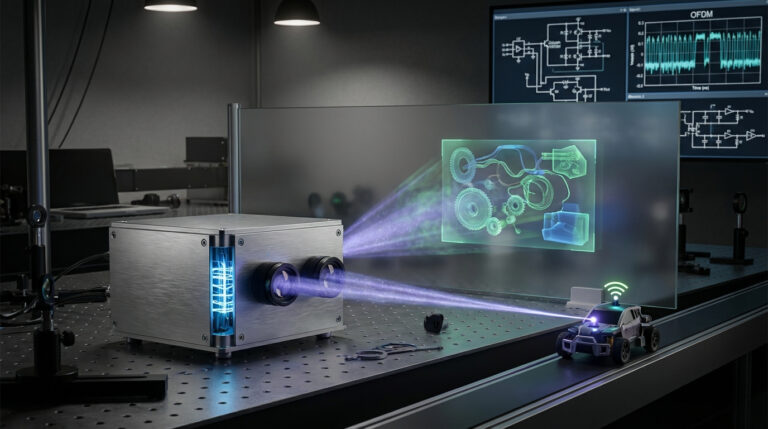
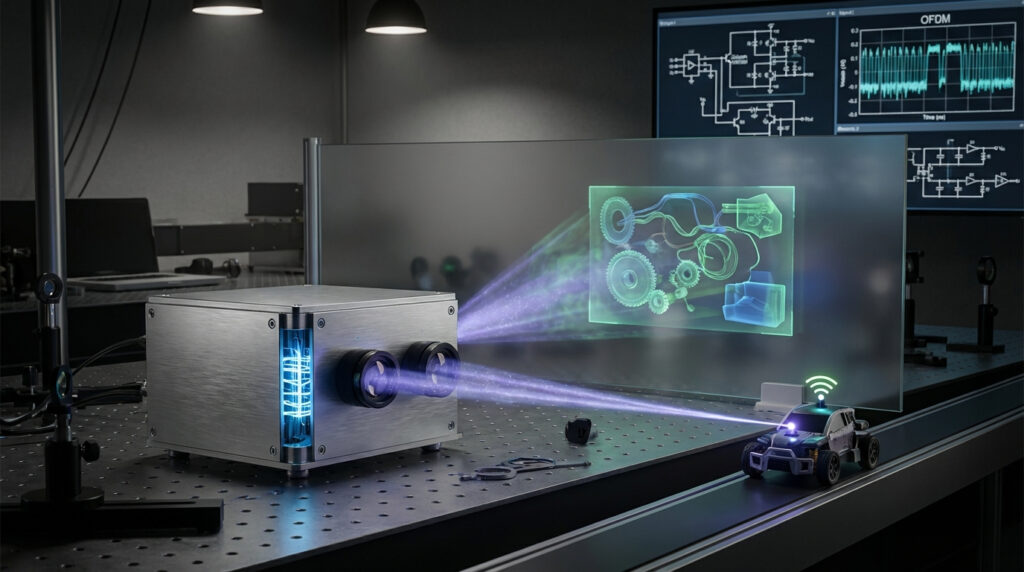
VLC is exactly what it sounds like: using visible light (from LED bulbs, for example) to send information instead of relying on traditional radio waves like Wi-Fi or Bluetooth. It’s a key player in future 6G networks because:
- Light is abundant indoors and safe for sensitive environments (like hospitals).
- It doesn’t interfere with radio signals, reducing congestion.
- It’s energy-efficient since lights are already on for illumination.
In other words, VLC turns your lights into wireless routers — but there’s a catch.
The Problem: Blockages and Uneven Light
Light can’t bend around corners or pass through furniture. So when someone walks between your lamp and your device, or when a table blocks the path, the signal drops. Even when it works, the light intensity can be uneven — some spots in the room get blazing-fast data, others struggle.
This is a huge challenge for Internet of Things (IoT) devices, which are everywhere in a smart home: sensors, thermostats, cameras, and appliances. These devices need constant, low-latency communication, even when the environment isn’t ideal.
The Solution: Intelligent Reflecting Surfaces (IRS)
Think of IRS panels as tiny, programmable mirrors that you can stick on walls. They don’t generate their own signals but redirect light beams from the LEDs to where it’s needed most. Instead of bouncing light randomly, these panels can adjust their angles — almost like steering a flashlight beam toward your phone — to improve connectivity in tricky spots.
But controlling hundreds of tiny mirror angles is complicated. That’s where the magic of optimization comes in.
Enter Teaching-Learning-Based Optimization (TLBO)
The research team used a clever algorithm inspired by how people learn in classrooms:
- Teacher Phase: The “teacher” (best solution so far) guides the entire group toward better performance.
- Learner Phase: Students (other solutions) learn from each other, sharing improvements and refining their skills.
This approach fine-tunes the orientation of every IRS mirror to maximize signal strength (Signal-to-Noise Ratio, or SNR) and ensure even lighting across the room. What’s cool? TLBO doesn’t need lots of fine-tuning like other algorithms (e.g., Genetic Algorithm or Particle Swarm Optimization). It’s fast, stable, and simple — perfect for real-time use.
What Did They Find?
The results are game-changing:
- Signal boost: SNR jumped from 43 dB (regular VLC) to 84 dB with TLBO-optimized IRS, even with people and furniture blocking the way.
- Uniform lighting: The system achieved a Coefficient of Variation (CoV) as low as 0.2 — meaning smooth, glare-free illumination with no dark spots.
- Smart placement matters: Devices positioned along room edges performed far better than those stuck in corners.
- Beats the competition: TLBO outperformed Genetic Algorithm and Particle Swarm Optimization in speed and stability, meaning faster adjustments and fewer glitches.
Why This Is Cool
This breakthrough does more than make your Wi-Fi faster — it reimagines indoor connectivity:
- Your lights become data highways: No extra antennas, no extra clutter.
- Faster than Wi-Fi: VLC can hit speeds in the gigabit range while staying energy-efficient.
- Blockage-proof smart homes: Mirrors redirect light so signals stay strong even when people move around.
- Uniform lighting + data: It improves both brightness and connectivity at the same time — something Wi-Fi can’t do.
What Could This Mean for You?
In the near future, you could walk into a room where every device connects instantly through the lights above you. Your smart thermostat updates faster, your security cameras stream without lag, and your VR headset feels wireless and seamless. Hospitals, factories, and even underwater sensors (where radio doesn’t work) could benefit from this dual-purpose light system.
This research shows that with clever algorithms like TLBO and smart reflective panels, the dream of a blockage-free, ultra-fast, and energy-efficient 6G network is closer than ever.
Check out the cool NewsWade YouTube video about this article!
Article derived from: Dixit, V., Kumar, A., Sharan, N. et al. Optimizing intelligent reflecting surface assisted visible light communication networks under blockage and practical constraints using TLBO for IoT applications. Sci Rep 15, 27400 (2025). https://doi.org/10.1038/s41598-025-12520-7