
What Just Happened?
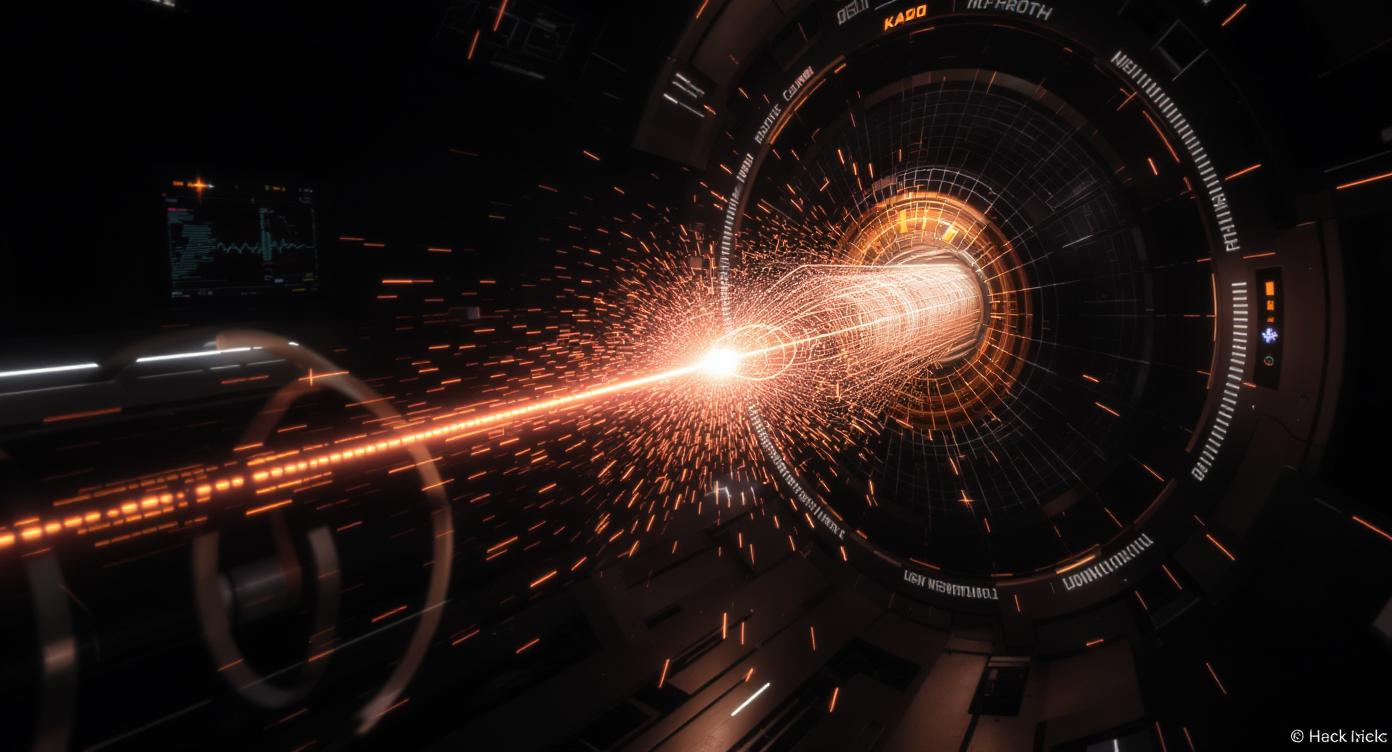
At a lab in Germany, a team of scientists working on the BGOOD experiment have taken the most detailed look yet at a bizarre process where a beam of light (a gamma ray) slams into a proton and produces two strange particles: a kaon (K⁺) and something called a Lambda(1520).
Yes, it sounds like science fiction—but it’s real. This experiment is like zooming in with an ultra-precise camera on one of nature’s weirdest quantum tricks, helping us uncover how matter behaves at its most fundamental level.
What Is Strange Matter and Why Should I Care?
The universe is made of particles, but not all of them are familiar like protons or electrons. Some, like the Lambda(1520), contain “strange quarks”—exotic building blocks that don’t exist in ordinary atoms. These strange particles only show up under extreme conditions, like those found in the early universe, black holes, or inside high-energy labs.
Studying strange matter helps scientists:
- Understand how quarks behave when they’re packed together in weird ways
- Explore forces that glue the universe together, known as Quantum Chromodynamics (QCD)
- Test theories about exotic particles that may behave like molecules made from quarks (so-called molecular-like hadrons)
What Did the BGOOD Experiment Discover?
By firing high-energy light at protons and measuring what comes out, BGOOD made the most precise measurements ever of how the Lambda(1520) is created—especially at very low momentum transfer, a sweet spot for detecting subtle effects.
Here’s the big deal:
- They confirmed that the contact term—a direct particle interaction—is the main way this reaction happens.
- Complicated exchanges (like mesons passing between particles) don’t play much of a role in this specific energy range.
- This suggests the Lambda(1520) might not be a simple particle, but a molecule-like object, made of other particles bound together. That’s new territory!
So… What’s the Point?
This may not build a new smartphone tomorrow—but here’s how it will benefit us:
- Blueprint for the Universe
Just like DNA unlocks how life works, understanding strange matter helps physicists decode the blueprint of matter. This knowledge feeds into technologies we haven’t imagined yet. - Fueling Quantum Innovation
Strange particle research contributes to fields like particle accelerators, nuclear fusion, and quantum computing, where tiny changes make massive impacts. - Cosmic Connections
These experiments simulate the high-energy conditions of the early universe, neutron stars, and black holes. That helps us understand how the cosmos—and maybe life itself—formed.
The Takeaway
The BGOOD experiment is pushing the frontiers of physics with pinpoint precision, revealing how the weirdest forms of matter behave when you shine a beam of light at them. It’s like listening in on the whisperings of the quantum universe—and what we hear could change the way we understand energy, matter, and our place in the cosmos.
Check out the cool NewsWade YouTube video about this article!
Article derived from: Rosanowski, E.O., Jude, T.C., Alef, S. et al. K+Λ(1520) photoproduction at forward angles near threshold with the BGOOD experiment. Eur. Phys. J. A61, 147 (2025). https://doi.org/10.1140/epja/s10050-025-01613-6