
The future of sensing just got entangled
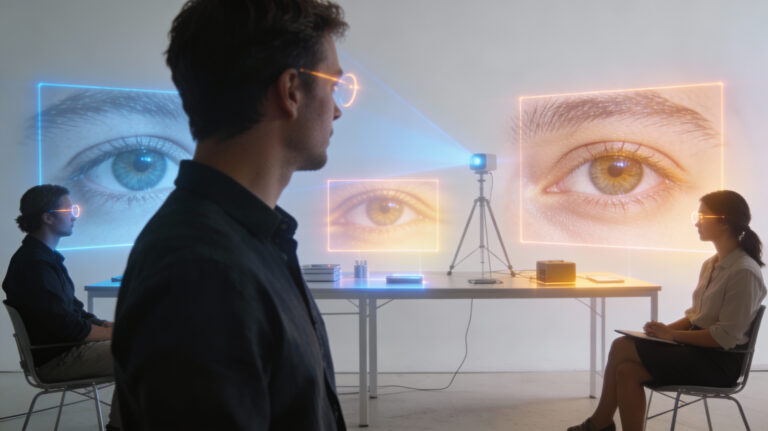
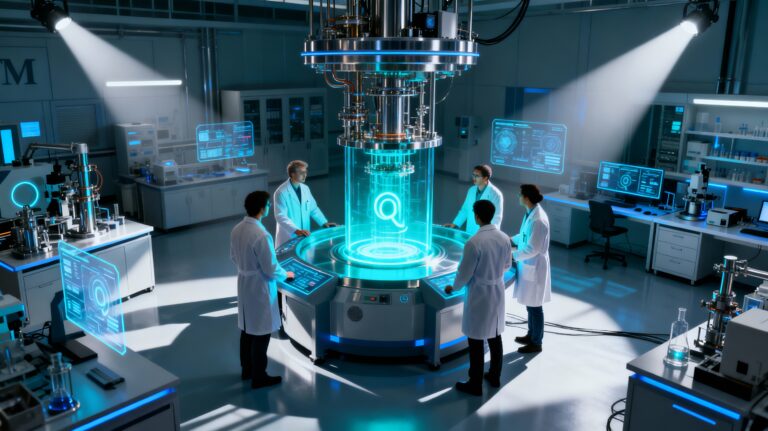
Quantum sensors already push the limits of precision, but what if we could link many sensors together and make them act as one?
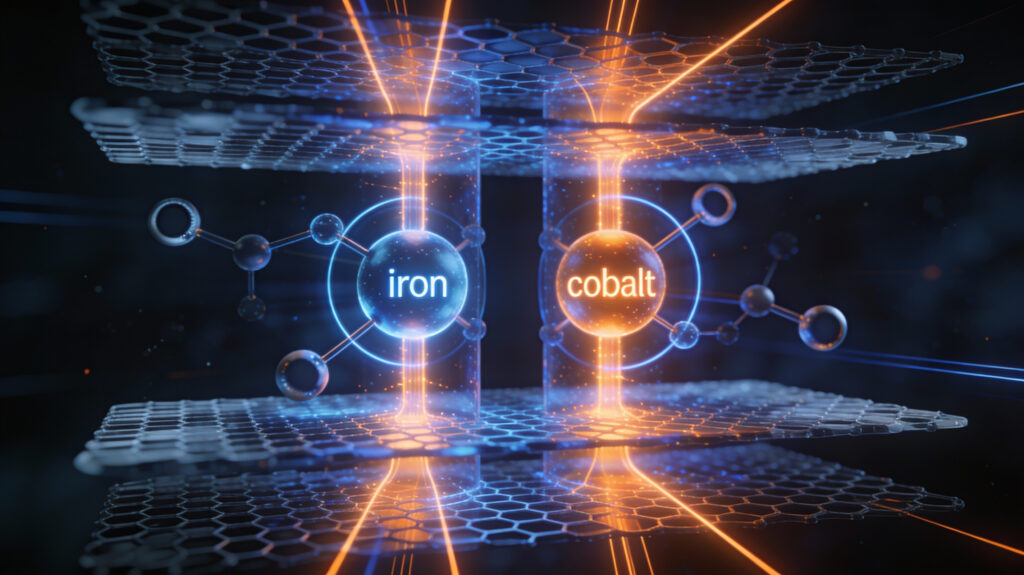
Researchers from KIST and Yonsei University in Korea have just shown how — using multi-mode N00N states to build a distributed quantum sensing (DQS) network that reaches Heisenberg-level precision.
Their new experiment demonstrates a four-mode “2002” photonic state shared between two remote interferometers, allowing them to estimate the average of two phases while outperforming the standard quantum limit (SQL) by 2.74 dB — all with simple, local detectors.
This breakthrough means smarter, lighter, and far more precise sensor networks — the kind that could redefine navigation, imaging, timekeeping, and even dark-matter detection.
For non-scientists: what’s actually going on
Imagine a choir instead of a group of soloists. Each singer (sensor) listens and adjusts their pitch (phase). When they sing separately, small errors creep in. But if they’re perfectly entangled — harmonized at the quantum level — they can hold pitch with superhuman accuracy.
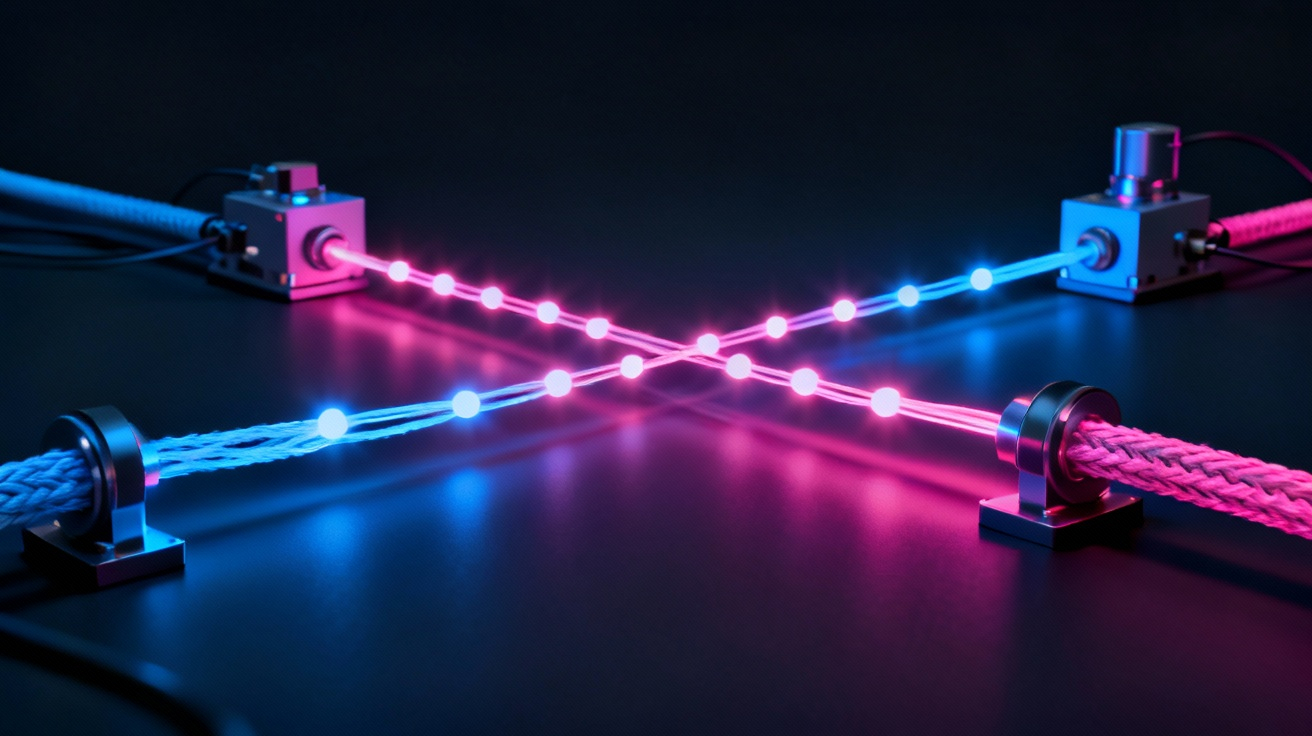
That’s what multi-mode N00N states do: they share a fixed number of photons across many paths (or “modes”), linking sensors so tightly that the entire network behaves like one instrument.
Each sensor adds its own small phase change to the photons, and when you combine all the data, you can extract a global parameter — like the average of all those phases — with extraordinary precision.
Here’s why it’s clever:
- Every node uses only local gear — a beam splitter and a photon counter.
- The “magic” comes from how the photons are entangled across the network before measurement.
- You don’t need a central super-detector. Each node measures locally; the quantum math ties them together.
The science deep-dive
From SQL to Heisenberg scaling
In classical sensing, your precision improves with more photons, but only as 1/N1/N1/N — the standard quantum limit.
Quantum entanglement, however, allows precision to improve as 1/N21/N^21/N2 — the Heisenberg limit, the ultimate bound of nature.
Multi-mode N00N states
A regular two-mode N00N state looks like ∣N,0⟩+∣0,N⟩,|N,0\rangle + |0,N\rangle,∣N,0⟩+∣0,N⟩,
meaning all photons in one arm or all in the other — a quantum superposition that boosts phase sensitivity.
A multi-mode N00N state, however, spreads those photons across many nodes: ∣ΨMN⟩=1d∑j=1d∣N,0⟩j+∣0,N⟩j.|Ψ_{MN}\rangle = \frac{1}{\sqrt{d}} \sum_{j=1}^{d} |N,0\rangle_j + |0,N\rangle_j.∣ΨMN⟩=d1j=1∑d∣N,0⟩j+∣0,N⟩j.
This global superposition makes each node part of a collective measurement. Even though each sensor is physically independent, the entanglement links their outcomes mathematically.
The experiment
- Resource: a four-mode “2002” state (two photons shared across two nodes).
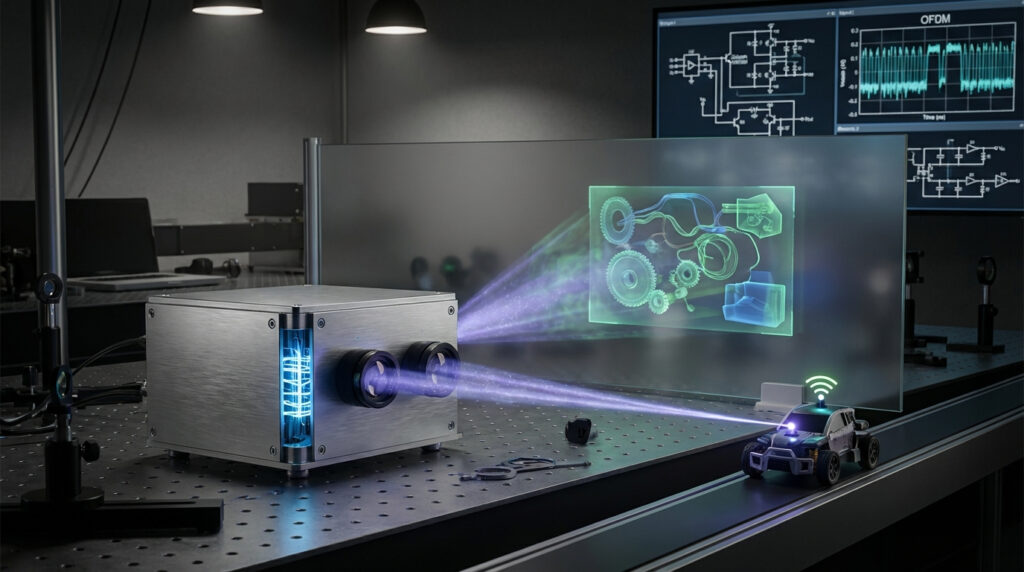
- Setup: each node hosts an interferometer with local phase shifters (waveplates).
- Measurement: 50/50 beam splitters + superconducting nanowire single-photon detectors (SNSPDs).
- Estimation: a maximum-likelihood algorithm reconstructs the global phase average (ϕ1+ϕ2)/2(\phi_1 + \phi_2)/2(ϕ1+ϕ2)/2.
The researchers showed that even with local detection, the setup achieves the quantum Cramér–Rao bound, confirming Heisenberg scaling.
Result: Fisher information ≈ 3.76, 2.74 dB better than the SQL.
Why this is cool (for everyone)
- Sharper results with less light: Entangled photons extract more information per photon, reducing power and exposure — perfect for delicate biological imaging or astronomical sensing.
- Networked intelligence: Instead of one massive instrument, many small sensors can share quantum links to form a global precision web.
- Better timekeeping: Distributed quantum clocks can synchronize far more precisely — boosting GPS accuracy and communications stability.
- Probing the unseen: Extreme sensitivity helps in detecting dark matter, gravitational ripples, or quantum noise in advanced materials.
- Built with real hardware: The experiment used practical optical components — a step closer to deployable, real-world quantum sensor networks.
How it works (step-by-step in plain terms)
- Entangle the photons: Two photons are generated and placed in a superposition so that you don’t know which path they’ll take — that’s the entanglement.
- Distribute the light: The photons are shared across multiple paths or sensors (modes).
- Encode the environment: Each path picks up its local phase (tiny timing or path shift).
- Measure locally: Each node runs its light through a small beam splitter and measures photon counts.
- Combine digitally: A computer merges the results, revealing the average phase with Heisenberg-level precision.
No spooky action at a distance — just clever quantum statistics that make the network smarter than the sum of its parts.
What’s next for distributed quantum sensing
- More nodes, fewer photons: Higher-mode N00N states can estimate averages across many sensors even when the photon count stays low.
- Chip-scale integration: Photonic metasurfaces could generate large-N, multi-mode states directly on-chip.
- Beyond averages: Future setups will measure weighted combinations of signals — key for complex imaging or adaptive radar.
- Robustness in the field: Researchers are building loss-tolerant, error-corrected versions for real-world environments.
- Turnkey toolkits: Expect plug-and-play quantum sensing modules where entanglement happens behind the scenes, delivering clean, high-precision readouts to engineers.
Check out the cool NewsWade YouTube video about this article!
Article derived from: Kim, D.-H., Hong, S., Kim, Y.-S., Oh, K., Lee, S.-Y., Lee, C., & Lim, H.-T. (2025, August 5). Distributed quantum sensing with multi-mode N00N states. arXiv. https://arxiv.org/abs/2508.02070