
Oceans are Earth’s circulatory system, distributing heat, oxygen, carbon, and nutrients through complex, ever-changing flows. But until now, modeling how substances like carbon dioxide or dissolved oxygen move through these swirling currents—especially at fine scales—required time-consuming and computationally expensive simulations.
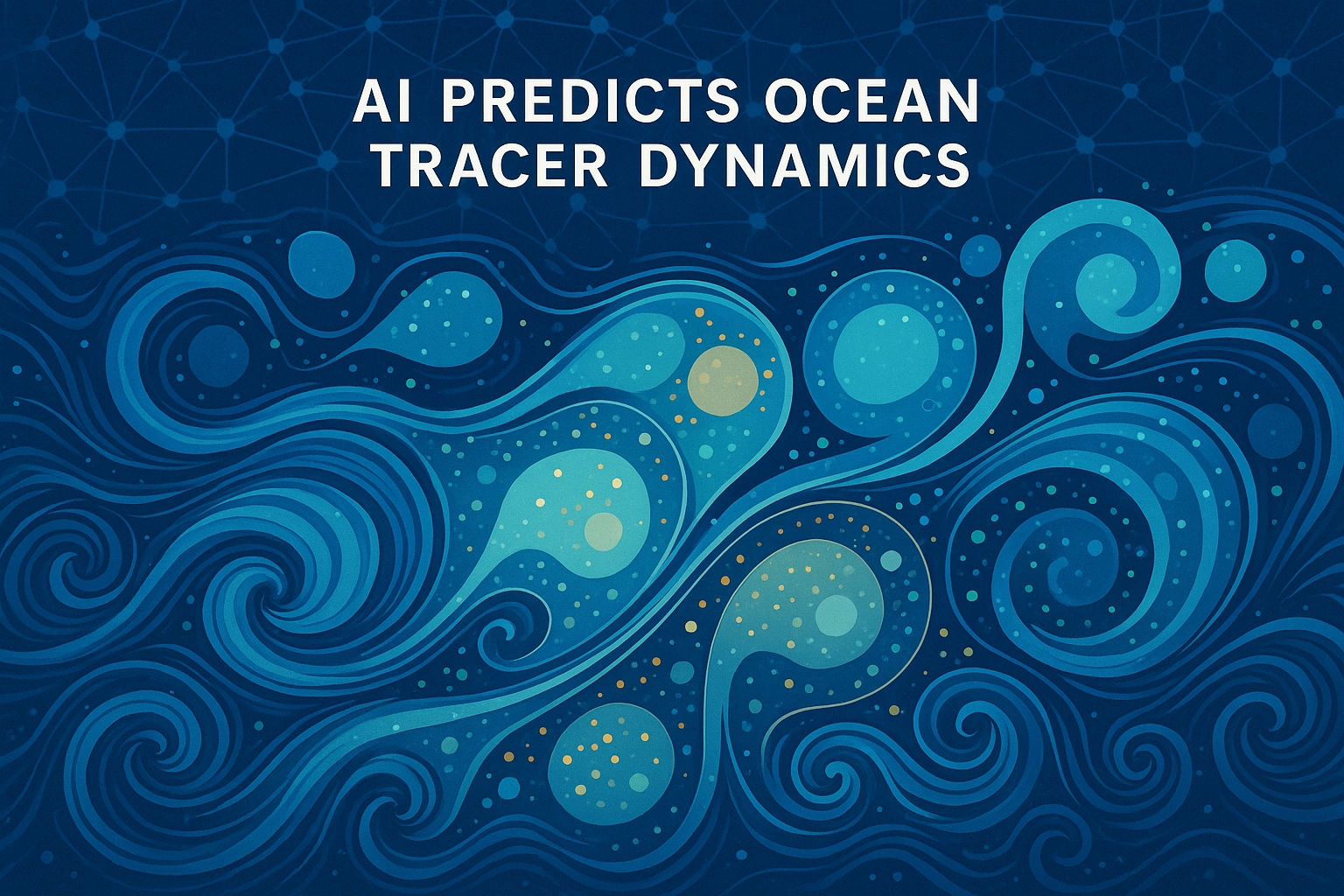
That’s changing fast. A new breakthrough in AI-powered modeling, developed by researchers Mayank Kumar Bijay and Jim Thomas, introduces LoConv, a custom-built neural network that predicts the dispersion of oceanic tracers with unprecedented accuracy and speed.
Why This Matters
From carbon uptake to oxygen distribution, ocean tracers are vital for understanding climate change, marine ecosystems, and global carbon cycles. Traditional methods rely on solving complex differential equations over time to model tracer behavior. That means massive compute costs, especially when dealing with dozens of different tracer types.
But the new research offers a game-changing alternative: predicting tracer fields directly from flow data using deep learning.
What’s New: Enter LoConv
The study explored several deep learning architectures—Autoencoders, UNet, GANs—but introduced a novel approach called LoConv (Local Convolution). Unlike typical convolution layers that use fixed filters across an image, LoConv allows for spatially varying weights, capturing the non-uniform, local dynamics of ocean flows.
Here’s what sets it apart:
- Better fine-scale accuracy: LoConv beats other models in reproducing small-scale tracer dispersion patterns, essential in submesoscale flows.
- Physics-informed learning: By integrating spectral loss, the network respects physical realism in the turbulent energy cascade.
- Massive speedup: Predicting 20 tracer fields takes just seconds with LoConv versus 3+ hours using traditional numerical methods.
Big Picture: From Model to Meaning
This isn’t just a tech upgrade—it’s a paradigm shift.
LoConv makes it possible to generate tracer predictions in near-real time, which could support real-world applications like:
- Climate modeling: Faster, more efficient simulations for Earth system models.
- Ocean monitoring: Real-time predictions during marine expeditions.
- Policy and planning: Rapid response modeling for carbon cycle or deoxygenation events.
And perhaps most impressively, the model generalizes well. Trained on just 14 combinations of Rossby number and energy ratio, it successfully predicts 26 unseen regimes—hinting at its broader usability.
Tracers Without Equations?
That’s the dream. This research brings us closer to a future where tracer transport, mixing, and fluxes can be inferred from the flow field alone—no equations, no solvers, just learned representations.
For oceanographers, climatologists, and Earth system scientists, this means less time waiting for simulations and more time interpreting results.
Final Thought
This is a stunning example of what happens when AI meets physics in a thoughtful, grounded way. The LoConv neural network isn’t just clever code—it’s a tool that could reshape how we understand our oceans and their role in the planet’s future.
As we enter a new era of climate urgency, tools like these might be what finally unlock real-time, high-resolution insights into Earth’s most mysterious system: the ocean.
Check out the cool NewsWade YouTube video about this article!
Article derived from: Bijay, M. K., & Thomas, J. (2025). Neural networks predicting submesoscale tracer dispersion. Journal of Geophysical Research: Machine Learning and Computation, 2, e2025JH000655. https://doi.org/10.1029/2025JH000655