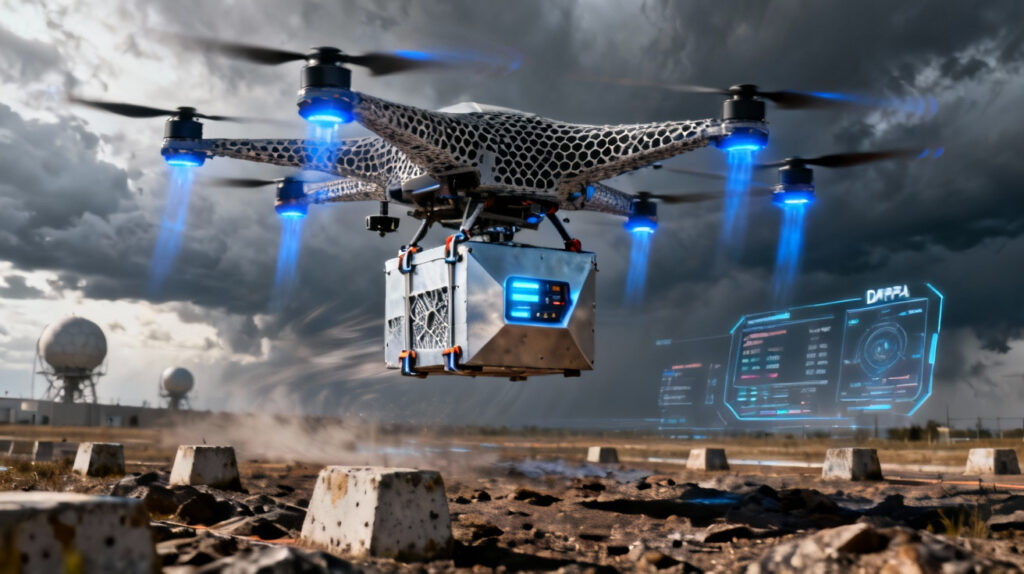


DARPA is tackling one of the toughest medical challenges on the battlefield—stopping uncontrolled bleeding deep inside the torso—with its new Medics Autonomously Stopping Hemorrhage (MASH) program. This ambitious initiative combines robotics, advanced sensors, and artificial intelligence to revolutionize battlefield medicine and save lives where surgical help may be hours—or even days—away.
Why MASH Is Groundbreaking
Non-compressible torso hemorrhage is one of the deadliest injuries in combat. Unlike bleeding from arms or legs, medics cannot simply apply a tourniquet to stop the blood loss. Currently, survival often depends on rapid surgical intervention, but in large-scale conflicts or remote battlefields, immediate access to operating rooms isn’t possible. MASH changes this equation by introducing autonomous robotic systems capable of searching inside the body to find hemorrhages and stabilize patients for up to 48 hours. That extra time could mean the difference between life and death for countless warfighters.
It’s “cool” in the sense that it represents the merging of life-saving medical techniques with cutting-edge robotics. Just as external defibrillators transformed how ordinary people respond to sudden cardiac arrest, MASH promises to empower medics with automated, intelligent assistance that takes on tasks once exclusive to surgeons.
How the Technology Works
At the heart of MASH is a combination of advanced sensors and AI-guided robotic tools. Imagine trying to locate a small but deadly internal bleed hidden within a landscape of vital organs and blood vessels. Now imagine a robotic system equipped with high-resolution imaging and AI software serving as a kind of GPS for the inside of the human body.
Step one is integration: the program will focus on connecting robotic systems with sensors powerful enough to detect hidden bleeds under battlefield conditions.
Step two is autonomy: AI-powered software will then guide tools directly to the injury site and apply interventions to stop the bleeding—even in the chaos of combat zones.
The ultimate vision is a device so streamlined that medics can use it with minimal training, relying on its automation to handle the complex task of internal hemorrhage control.
What Will Be Different
If successful, MASH could completely shift pre-hospital trauma care on the battlefield:
- Extended survival time: Patients could remain stable for 48 hours or longer, giving military teams the window they need to evacuate them to safe surgical facilities.
- Reduced dependence on immediate surgery: Instead of requiring a surgeon at the point of injury, MASH would allow medics to manage extreme cases with high-tech backup.
- Simplified life-saving tools: Like AEDs, the next generation of robotic trauma systems could guide medics through a simple interface, eliminating guesswork.
- Broader impact beyond the battlefield: Civilian trauma care—like mass-casualty events, car accidents, or rural medicine—could benefit from this breakthrough tech.
When We Can Expect It
The MASH program is structured as a three-year effort running through two main phases. The first phase focuses on integrating sensors and robotic platforms to identify bleeds, while the second develops the AI-driven autonomy to stop them. Researchers and developers will officially kick off with a Proposers Day webcast on September 18, 2025, where DARPA welcomes collaboration from academia, industry, and medical communities.
If milestones are met, we could see functional prototypes tested within just a few years. This means that by the late 2020s, automated robotic trauma systems could be deployed in both military and eventually civilian emergency medicine.
Final Thoughts
MASH is a bold glimpse into the future of trauma care. By combining robotics, sensors, and artificial intelligence into a single autonomous unit, DARPA is moving battlefield medicine closer to science fiction—where machines not only assist medics but directly save lives under impossible conditions. It’s one of those innovations that makes you realize just how far technology can go in rewriting the rules of survival.
Check out the cool NewsWade YouTube video about this article!
Sources:
Defense Advanced Research Projects Agency. (2025, September 8). Medics autonomously stopping hemorrhage (MASH) program aims to revolutionize battlefield trauma care. https://www.darpa.mil/news-events/2025-09-08-mash
Tadjdeh, Y. (2025, September 8). DARPA’s robotic system could save wounded soldiers on the battlefield. National Defense Magazine. https://www.nationaldefensemagazine.org/articles/2025/9/8/darpas-robotic-system-could-save-wounded-soldiers-on-the-battlefield
U.S. Government Contracting Opportunities. (2025). DARPA MASH Program webcast registration. https://sam.gov/opp/9a472b4a3cb64b488cfdd331126a2da6/view