
If you could power a soft robot with a single AAA battery and no bulky pump, what would you build? A new study introduces Liquid Metal Shapeshifting (LMSS)—a droplet-based, low-voltage fluidic engine that literally tears itself apart and zips back together to push liquids with surprising force. It’s simple, safe, and small enough to wear on your wrist.
In this explainer, we’ll keep the physics crisp for science fans, while translating the big ideas for everyone else.
The Big Idea: Controlled Chaos for Useful Work
Droplets normally hate instability—push them too hard and they rupture. LMSS leans into that chaos and tames it.
- Current + Magnet = Lorentz Push
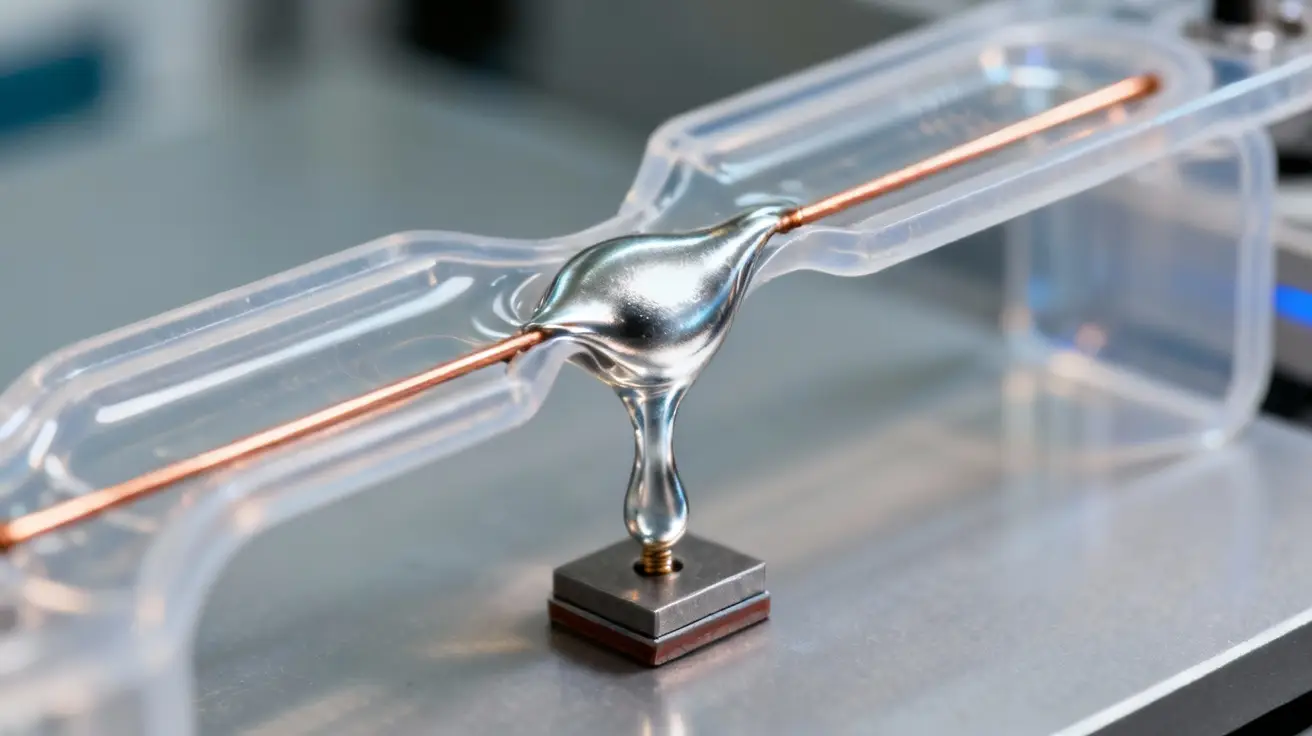
A tiny voltage drives current through the liquid metal droplet. A nearby magnet creates a magnetic field. Together, they generate a Lorentz force that stretches the droplet along a microchannel. - Snap! (But Productively)
As the droplet elongates, surface tension fights back. At a critical stretch (perimeter ratio ε ≈ 1.8, where the Weber number ~ 1), the droplet pinches off into two parts. Current stops instantly; Lorentz force vanishes. - Heal and Go Again
Surface tension pulls the two pieces back together (coalescence), re-closing the circuit. Current flows again, the Lorentz force returns, and the cycle repeats—an autonomous fluidic oscillator that pumps liquid forward.
Because the power stroke (Lorentz-driven stretch) and recovery stroke (surface-tension snapback) are asymmetric, the surrounding fluid moves net forward each cycle—no valves required.
Why Engineers (and Makers) Should Care
- Low voltage, high punch: Mean operating voltages 0.01–0.1 V; AAA demo at 0.2–0.35 V around 6 A. Power down to 0.006 W in optimized magnetic circuits.
- Performance: A single unit shows specific pressure ~33.33 GPa·m⁻³ and specific flow ~7.71 kl·min⁻¹·m⁻³, surpassing published micro-pumps and some commercial units—at the lowest recorded voltage in this class.
- Scalable like LEGO:
- Series → more pressure (4 units reached 24 kPa)
- Parallel → more flow (4 units hit ~3.72 mL min⁻¹)
- Self-organizing synchronization up to ~71% in series.
- Form factor: Soft PDMS, 15 mm long body, 0.1 mm channel height, 0.45 g mass. Quiet, low vibration, and embeddable.
- Cost & manufacturability: ~45 pence / $0.57 prototype using standard soft-lithography/PDMS methods; readily scalable.
How It Works (No PhD Required)
- Think of the droplet as a tiny muscle that stretches when you tap it with electricity in a magnetic field.
- Push it far enough and it snaps into two—like a stretched water balloon that splits cleanly.
- It then heals back into one piece almost instantly. Each stretch-snap-heal cycle moves fluid forward.
- Flip the current and the pump reverses, giving bidirectional flow on demand.
Design Knobs You Can Turn
- Electrodes: Asymmetric tips increase pressure; symmetric tips favor higher flow.
- Channel width: ~5 mm excels for pressure; 10 mm maximizes flow.
- Current & magnet strength: More Lorentz force → higher frequency and pressure—up to anchoring limits.
- Droplet length & height: Keep channels low (~0.1 mm) so surface tension wins the recovery race; tall channels risk droplet shedding.
- Fluid: 1 M NaOH works best (reduces oxide, raises surface tension). Neutral liquids and air can work briefly, but oxidation will limit stability.
Field Demos You Can Steal
- Soft Bender: A 3D-printed actuator bends >90° in <12 s under LMSS negative pressure.
- Antagonistic Pairing: One inlet + one outlet actuator for two-way motion—no valves.
- Wearable Color Pixels: LMSS circulates RGB fluids into soft “chromatophores” for camouflage and dynamic patterns in smart fabric.
- Wrist-Pump + UV Skin: A compact LMSS watch circulates TiO₂ suspension under a silicone “skin,” cutting UVA power ~40% at 200 mg mL⁻¹.
Safety, Reliability, and Practicalities
- Human-safe voltages: Millivolt operation is well below safety thresholds.
- Quiet & cool: Thermal rise stabilizes at safe levels; operation is silent with minimal vibration.
- Durability: >7,000 cycles demonstrated; pump tolerates ~3 kPa back-pressure per droplet when inactive.
- Electrolysis control: Use a supply with current/voltage limits or a simple voltage clamp/switch; alkaline battery internal resistance also helps.
What This Could Unlock Next
- Truly untethered soft robots with onboard soft actuation.
- Patch-size drug delivery or point-of-care diagnostics where pumps used to be the bottleneck.
- Adaptive garments that manage heat, camouflage, or UV exposure on the fly.
- Fluidic computing that needs a compact oscillating pressure clock.
In short, LMSS turns droplet physics into a platform—a fundamental building block for the next generation of fluid-driven soft machines.
For the Deeply Technical
- Instability threshold: ε ≈ 1.8 (perimeter ratio) with We ~ 1 at rupture; pinch-off governed by thin-film instability.
- Cycle dynamics: Increasing current raises frequency but lowers duty cycle (shorter breakup time; coalescence time largely material-limited).
- Magnetic circuit optimization: Closed magnetic paths can raise B-field >8×, cutting required power ~64× (to ~0.006 W) while boosting specific pressure/flow per Watt (up to ~5332 GPa·m⁻³·W⁻¹ and ~1234 kl·min⁻¹·m⁻³·W⁻¹ in simulation).
Key Specs at a Glance
- Voltage: ~0.01–0.1 V typical; AAA demo 0.2–0.35 V
- Current: ~3 A breakup threshold; demos at ~6–8 A
- Power: 0.006–0.4 W (with magnetic optimization on the low end)
- Pressure (4× series): ~24 kPa
- Flow (4× parallel): ~3.72 mL min⁻¹
- Unit mass: ~0.45 g
- Channel height: ~0.1 mm
- Prototype cost: ~$0.57
Plain-English Takeaway
This pump doesn’t need gears or valves. It just rides the physics of a liquid metal droplet—stretch, snap, heal, repeat—to move fluid. Because it’s tiny, soft, and cheap, it could finally let soft robots, wearables, and lab chips carry their own fluidic power without clunky hardware.
Check out the cool NewsWade YouTube video about this article!
Article derived from: S. Firouznia, C. Romero, H. Philamore, A. Conn, M. Garrad, and J. Rossiter, “ Shapeshifting Liquid Metal Droplets for Soft Fluidic Machines.” Adv. Mater. (2025): 2420265. https://doi.org/10.1002/adma.202420265