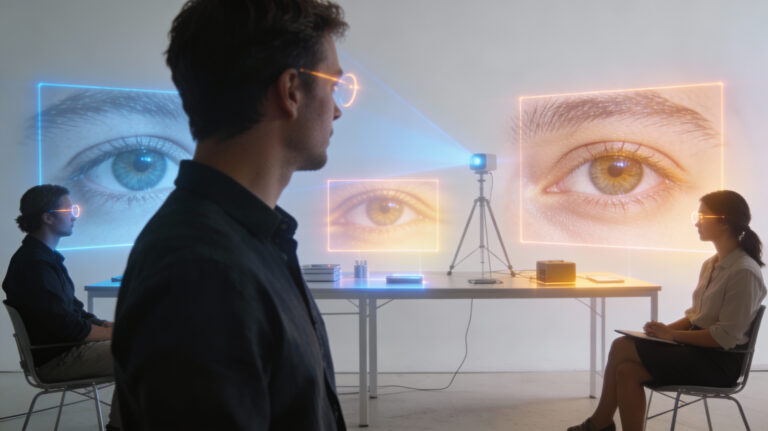

Light is more than just brightness. It holds layers of information — from brightness (amplitude) and color (wavelength) to vibration direction (polarization) and wave shape (phase). Traditionally, cameras and sensors only capture part of this data. However, a breakthrough called High-Dimensional One-Shot Optical Field Compressive Sensing (HOOCS) is about to change everything.
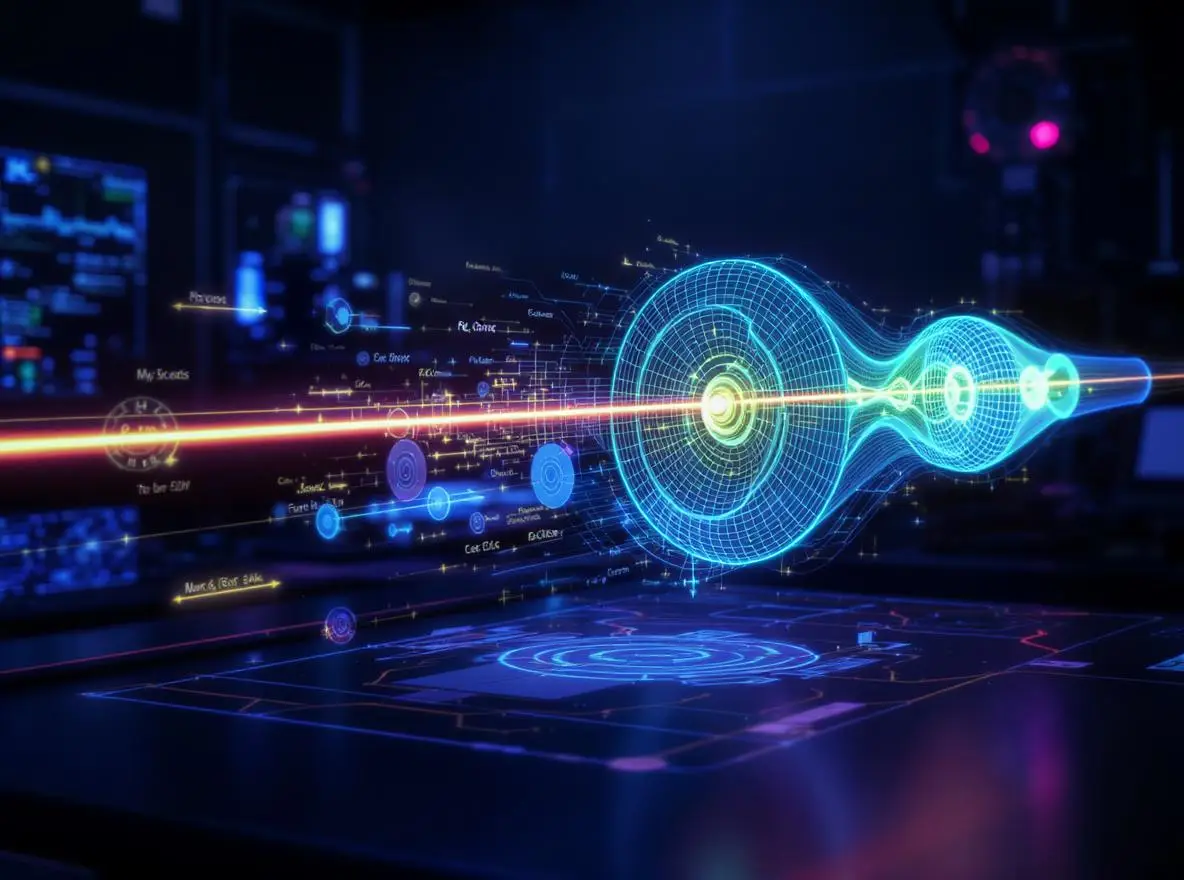
Instead of taking multiple measurements over time, HOOCS records all of a light field’s properties — amplitude, phase, polarization, and wavelength — across space and time in a single shot. In other words, it’s like taking a photo that not only shows an image but also reveals how every light wave twists, bends, and changes in real time.
How It Works
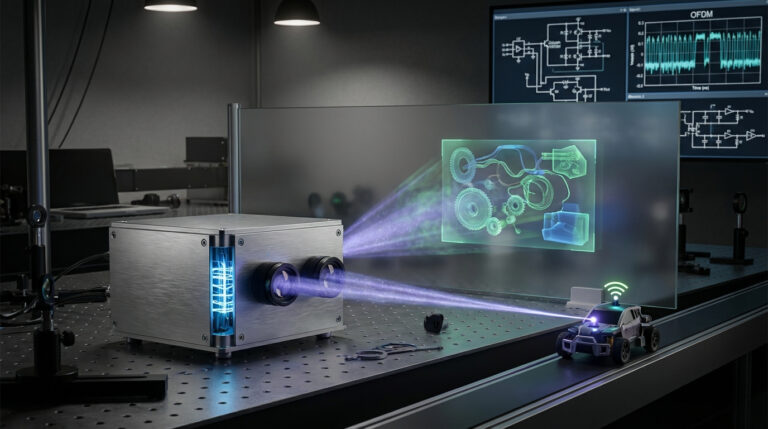
To achieve this, HOOCS combines advanced optical techniques with AI-powered reconstruction. First, coded aperture snapshot spectral imaging (CASSI) compresses high-dimensional light data into a single 2D sensor image. Next, point-diffraction holography decodes the wave’s phase, exposing hidden patterns such as optical vortices. Then, spectropolarimetry measures polarization in fine detail. Finally, a neural network reconstruction algorithm transforms the compressed data into a full 3D+time (spatiotemporal) map of the light.
Because these steps work together seamlessly, even the most complex “structured light” — like spiraling optical vortices, radially polarized beams, or ultrafast polarization-gated pulses — can be captured without missing any details.
Why It’s Cool
This isn’t just about prettier pictures; it’s a leap forward for science and technology. For example, in attosecond science, knowing the precise polarization of ultra-fast laser pulses allows researchers to create sharper, more controlled X-ray flashes for observing atoms in motion. Likewise, in quantum communications, mapping light’s polarization and phase helps encode and transmit more data securely.
Moreover, in biological imaging, structured light beams can probe deeper into tissues with less damage. Because HOOCS captures everything in one shot, it can also monitor fleeting events in particle physics, materials research, and astronomy — where repeating an experiment may be impossible.
Looking ahead, scientists believe HOOCS devices could be made compact by integrating metasurfaces and real-time AI processing. This would make the technology practical for fieldwork, lab experiments, and even portable sensing tools.
In short, HOOCS doesn’t just take a picture — it captures the soul of light, revealing dimensions our eyes have never seen.
Check out the cool NewsWade YouTube video about this post!
Article derived from: Hu, Y., Men, T., Yan, M. et al. High-dimensional one-shot optical field compressive sensing of structured light. Nat Commun 16, 7370 (2025). https://doi.org/10.1038/s41467-025-62526-y