
What If Machines Could Warn You Before Breaking Down?
Imagine if a factory machine could alert you, “Something’s off in my gearbox—please check me before I fail.”
That level of intelligence is now possible thanks to a breakthrough from a team of researchers who developed a powerful method to detect gear problems even when machines change speed.
This matters because rotating machinery—like gearboxes in wind turbines, industrial motors, or vehicles—rarely run at a constant speed. Traditional methods struggle to detect faults when the pace isn’t steady. But this new technique thrives in those real-world conditions.
Why Gear Faults Are So Hard to Detect
Gearboxes are critical components in many mechanical systems. When they fail, it can shut down entire production lines or systems.
Old-school detection methods analyze vibration signals to catch faults. These work reasonably well if the machine runs at a constant speed. But when speeds vary—as they often do in practice—those signals become distorted, and faults are easily missed.
This challenge has limited the reliability of condition monitoring systems for years. The new method overcomes it by using a hybrid, layered approach.
How the Hybrid Detection Method Works
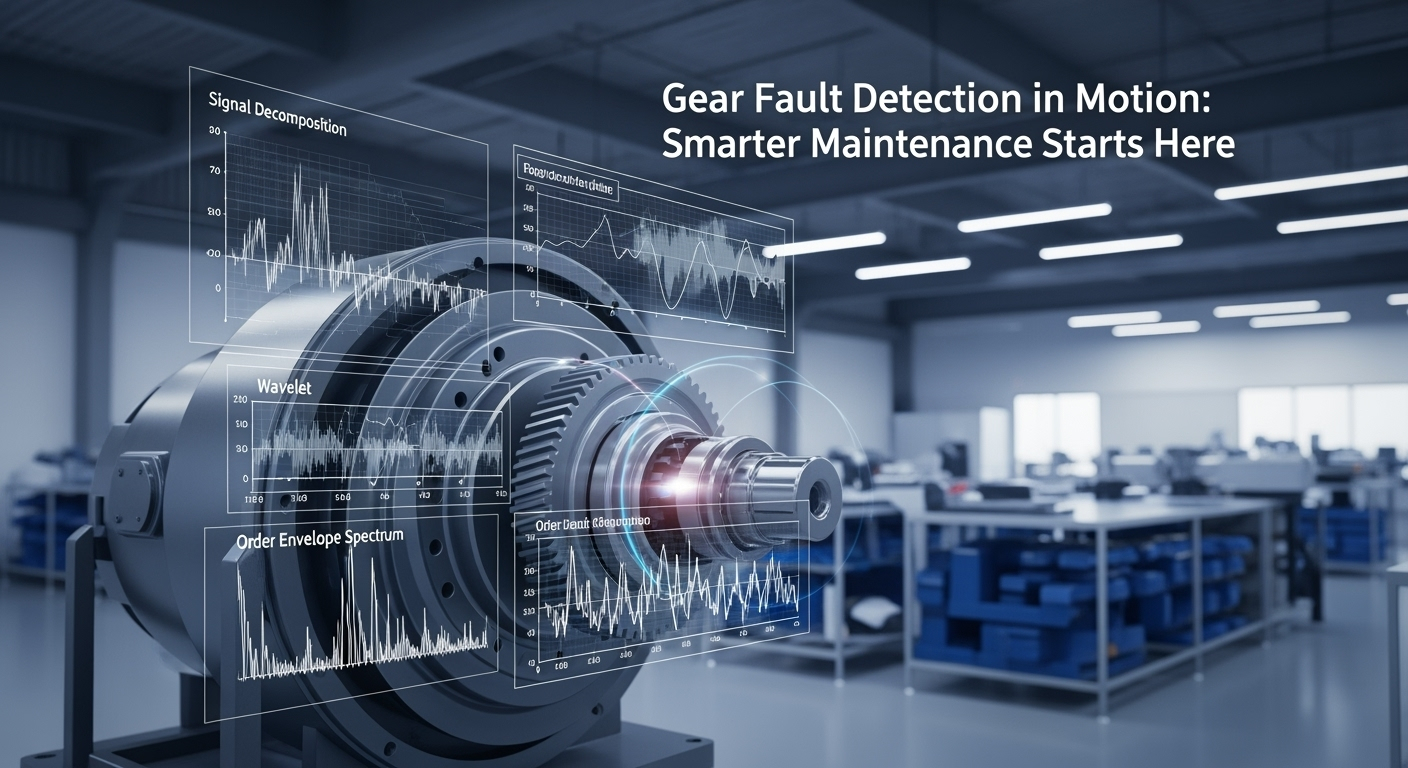
The research team combined three advanced techniques to form one powerful diagnostic system:
- Improved Complete Ensemble Empirical Mode Decomposition with Adaptive Noise (ICEEMDAN): This method breaks the vibration signal into multiple layers, isolating useful components while reducing noise and distortion.
- Kurtogram-Based Selection: A kurtogram helps identify the layer that contains the gear fault’s unique signature by focusing on impulsive signals caused by gear damage.
- Wavelet Denoising and Principal Component Analysis (PCA): This step removes extra noise and enhances the signal clarity.
- Order Tracking Analysis (OTA): This final step adjusts for speed variation, converting the signal to a speed-based domain and allowing the fault pattern to stand out clearly.
What Happened in Testing?
The team tested three types of gear damage using a lab setup with real hardware. These included:
- A partially extracted tooth
- A fully extracted tooth
- A generalized wear pattern
They ran each gearbox in three modes: acceleration, constant speed, and deceleration. Traditional tools like spectrum analysis and cepstrum failed to detect defects in changing speeds.
But the new hybrid method succeeded every time. It correctly identified gear defects even when speeds were changing. It even picked up unrelated belt issues as a bonus, showing it can detect multiple types of faults at once.
Why This Matters to Industry
This breakthrough offers several key benefits:
- Prevents unexpected machine failures
- Reduces costly downtime
- Enables maintenance to be done only when needed
- Works with real-world speed fluctuations
- Can detect multiple faults, not just gear issues
This method can be deployed in factories, wind farms, transportation systems, or anywhere rotating machinery is critical to operations.
The Future: Smarter, More Predictive Maintenance
The researchers believe the next step is combining this method with artificial intelligence. That could allow machines to automatically classify faults, predict failure times, and make smart maintenance decisions—without needing a huge amount of labeled training data.
With AI integration, fault detection could become fully autonomous, fast, and highly accurate.
Final Thoughts
For decades, detecting gear faults has been a challenge—especially when machines don’t run at a constant speed. This new hybrid method finally solves that problem, making it possible to detect failures early and accurately in dynamic conditions.
Even without a background in mechanical engineering, it’s easy to appreciate the power of this solution. It helps make machines smarter, safer, and far more reliable.
Check out the cool NewsWade YouTube video about this article!
Article derived from: Ouelaa Z, Djebala A, Younes R, et al. Advanced gear fault diagnosis in non-stationary conditions with an improved CEEMDAN-wavelet denoising technique. Advances in Mechanical Engineering. 2025;17(7). doi:10.1177/16878132251356546