
Bogong Moths Use the Stars to Find Their Way—And It’s Blowing Scientists’ Minds
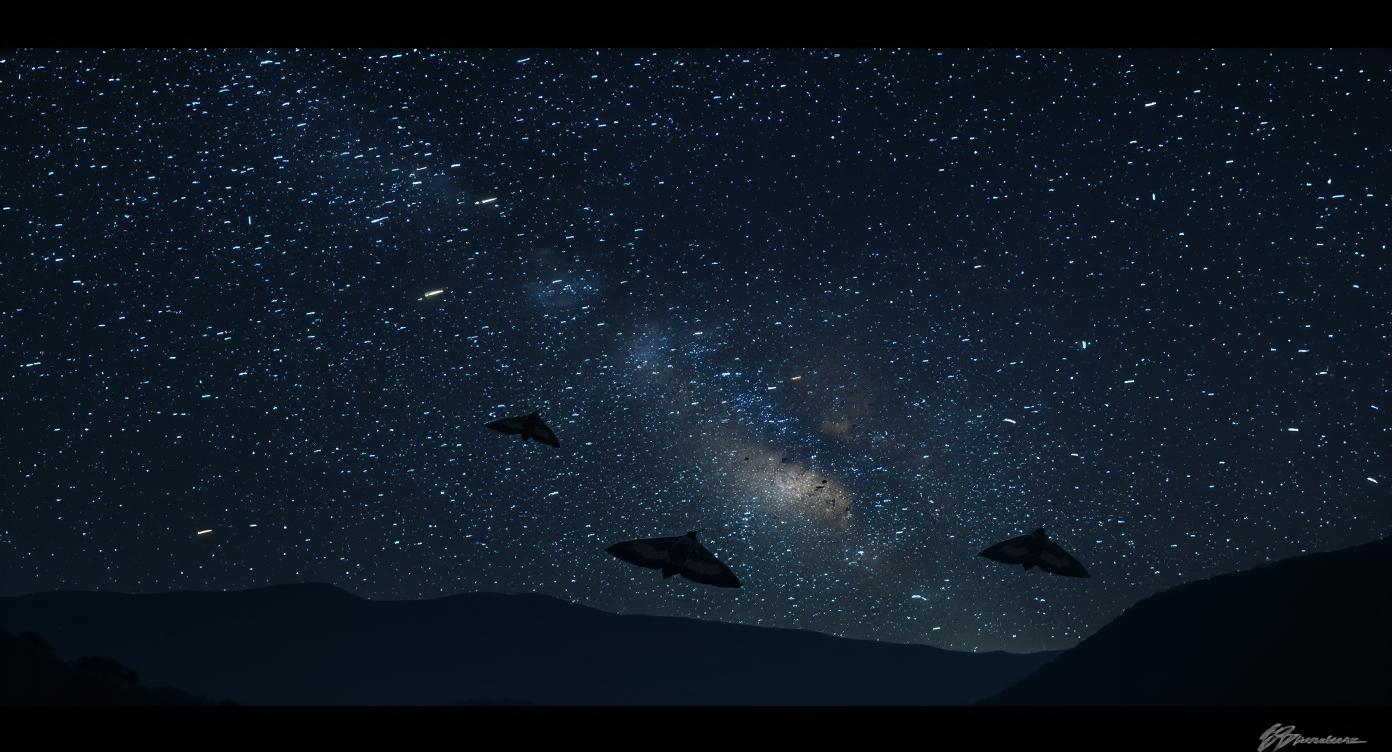
Every year, billions of Bogong moths embark on an epic 1,000 km journey across southeastern Australia. They leave their breeding grounds and head for a series of cold, dark alpine caves they’ve never visited before. Now, a groundbreaking study published in Nature (2025) has revealed the secret behind this incredible migration: Bogong moths use the stars to navigate at night.
Yes, you read that right—these insects use the night sky as a compass.
The First Insect Ever Proven to Use a Stellar Compass
Until now, birds and humans were among the few species known to use celestial cues for long-range orientation. But this new research—conducted by a team of neuroscientists, biologists, and physicists—shows that Bogong moths are the first invertebrates proven to use a stellar compass to follow a precise, inherited migratory route.
Using advanced flight simulators, researchers tested moths under various sky conditions:
- With a clear night sky: moths flew in the correct direction.
- When the Earth’s magnetic field was “nulled”: they still flew correctly under the stars.
- When the stars were scrambled or skies were cloudy: they got confused—unless magnetic cues were present.
This dual-system compass—stellar and magnetic—makes Bogong moths expert nighttime navigators.
They’re Born With the Map—And Use the Milky Way
Here’s what’s mind-blowing: the moths don’t learn the route. They’re born with an internal program that tells them which direction to fly. Neurons in their tiny brains literally fire strongest when they face south, as if their internal GPS lights up when aligned with their inherited goal.
Scientists even suspect they recognize the bright stripe of the Milky Way, especially the Carina nebula region, to lock in their orientation.
What Makes This Even More Incredible?
- They fly at night.
- They navigate to places they’ve never seen.
- They keep the course even as the stars rotate across the sky during the night.
- They can switch to magnetic cues when clouds hide the stars.
This puts their navigation ability on par with migratory birds—and they do it all with a brain the size of a grain of rice.
Why It Matters: Tiny Moth, Big Implications
This discovery isn’t just a curiosity—it’s a window into how brains process complex environmental cues. It could:
- Inspire bio-navigation systems for drones or robots operating without GPS.
- Help us understand how pollution or climate change affects migrating insects.
- Shed light on how other species—including monarch butterflies—navigate.
Bogong moths may be small, but they’ve just made a huge mark in the world of science.
Final Thought
For thousands of years, humans have looked to the stars for direction. Now, we know that the Bogong moth—a humble insect—has been doing the same all along.
Their journey is a testament to nature’s ingenuity, and a reminder that even in the darkest night, something is always guiding the way.
Check out the cool NewsWade YouTube video about this article!
Article derived from: Dreyer, D., Adden, A., Chen, H. et al. Bogong moths use a stellar compass for long-distance navigation at night. Nature (2025). https://doi.org/10.1038/s41586-025-09135-3