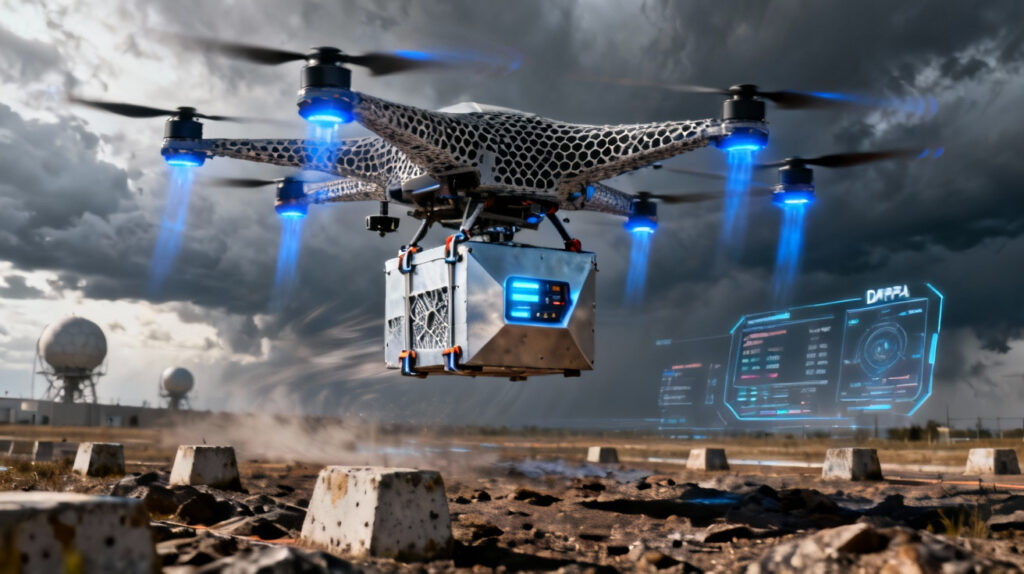


Robots can grip. Now they can feel—and even pick the best fingertip for the job. Cambridge researchers have paired a single-material electronic skin that senses twist with an automated benchmarking platform that ranks and swaps soft fingertips in minutes. Together, they unlock fast, robust, and sustainable touch for real-world tasks—from turning screws to handling fruit.
Why this is cool
- Human-like intuition: The e-skin detects shear—the sideways, twisty forces that determine slip, drag, and torque. That’s what your fingers use to know when a screw is tight or a lid is stuck.
- Plug-and-play fingertips: A robot can auto-swap among 15+ fingertip designs (materials + sensing types) in ~half a minute, then benchmark them in under 30 minutes to pick the optimal one for a task, environment, or even lifecycle stage.
- Sustainable by design: Some tips use biodegradable gels and organogels; worn tips can be recast or composted, pushing robotics toward a circular economy.
How it works (one pipeline, two breakthroughs)
- Single-material e-skin that “feels” twist
A soft, conductive hydrogel fingertip sits inside a ring of electrodes. As the robot twists a tool (say, a screwdriver), tiny conductivity shifts ripple through the gel. An electrical impedance tomography (EIT) board samples hundreds of channels each frame to capture that pattern.
Instead of reconstructing a full image, a physics-first reduced-order model compresses the data to two parameters:
- σ (sigma) maps to torque
- k maps to handle diameter
Because the team precomputes a giant library of simulated signals, the fingertip can snap-match live data to the best entry and instantly estimate torque and diameter. In tests, those estimates tracked ground truth closely.
- Automated benchmarking and fingertip selection
Dexterity isn’t one-size-fits-all, so the second system loads, tests, and ranks different fingertip designs automatically. It measures:
- Force–deformation in multiple directions (soft ↔ rigid, anisotropy, hysteresis)
- Sensitivity to light touches, including human touch
- Temperature response for safety and resilience
- Localization (EIT tips achieved sub-millimeter precision in trials)
With those metrics, the robot self-configures: it picks the fingertip that best fits the job—gentle fruit picking, precise torque turns, guided human interaction, or robust force control—and can swap as conditions change.
What this enables next
- Real-time, slip-aware torque control: Turn screws tightly without stripping; feel slip before it happens.
- Task-optimized hands: One hand, many fingertips—assembly today, delicate packaging tomorrow.
- Lower cost, higher durability: Single-material e-skin avoids complex stacks and embedded optics that can fail.
- Greener robotics: Recastable or biodegradable tips support repair, reuse, and responsible disposal.
When we can see it
- Now → 12 months: Research labs and advanced prototyping teams integrate both systems for tool use, pick-and-place, and cobot demos.
- 12–24 months: Pilot deployments in electronics assembly, medical device kitting, and R&D automation, where gentle handling and torque precision matter.
- 2–4 years: Broader factory and fulfillment adoption, aided by maturing software stacks (grasp planners + fingertip selectors) and drop-in fingertip kits.
- Longer-term: Service robots that reconfigure touch on demand—swapping to clean, guide, or assist safely around people.
Check out the cool NewsWade YouTube video about this article!
Article derived from:
Trehan, D., Hardman, D., & Iida, F. (2025). Soft shear sensing of robotic twisting tasks using reduced-order conductivity modeling. Sensors, 25(15), 5159. https://doi.org/10.3390/s25165159
Hardman, D., Dai, B., Guan, Q., Georgopoulou, A., Iida, F., & Hughes, J. (2025). Automated benchmarking of variable-property soft robotic fingertips to enable task-optimized sensor selection. Advanced Science, 2025, e09991. https://doi.org/10.1002/advs.202509991