
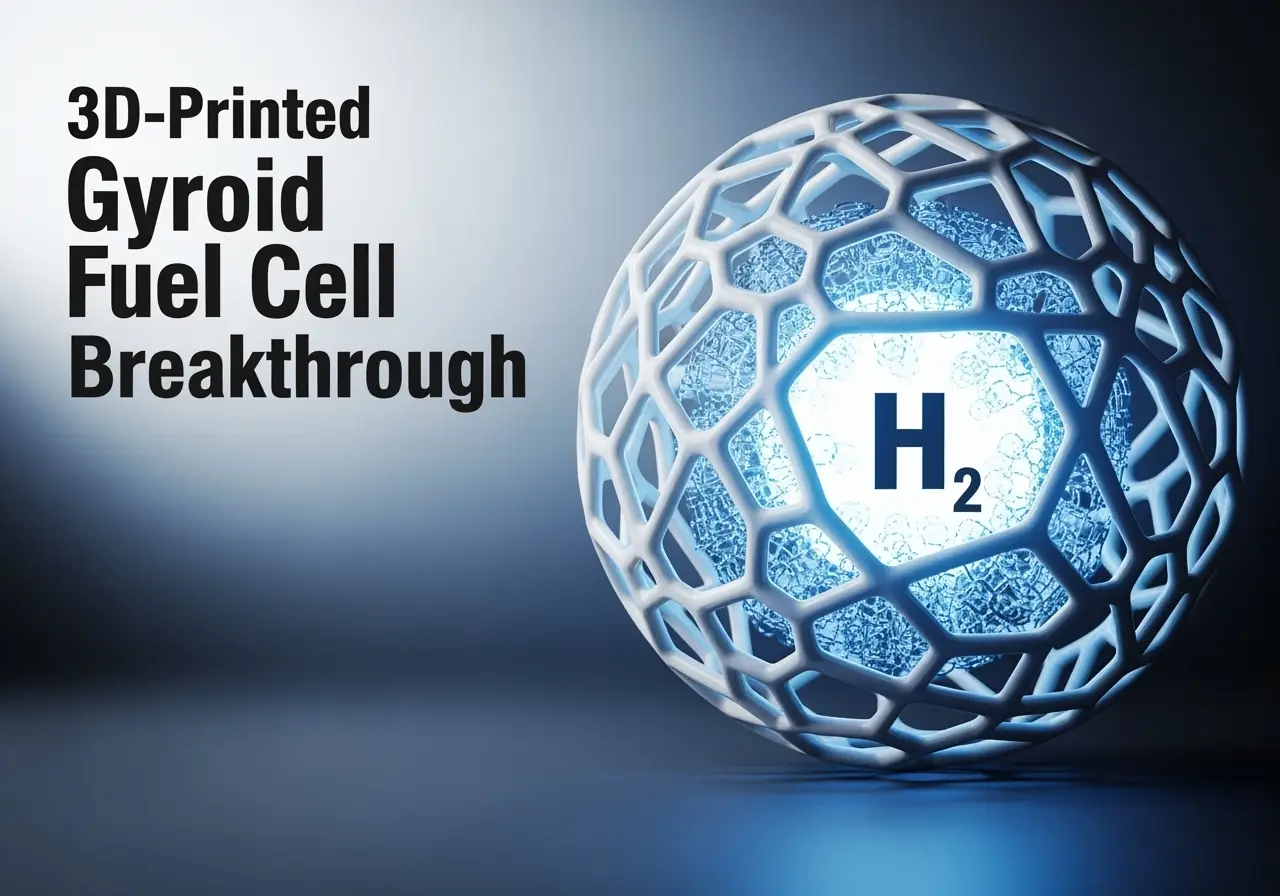
A research team at the Technical University of Denmark (DTU) has unveiled a breakthrough in fuel cell technology: the 3D-printed gyroidal solid oxide cell (3D-SOC). This innovation combines fuel cell and electrolyzer functions in a single ceramic unit, eliminating bulky metal interconnects and paving the way for lighter, more efficient hydrogen systems.
Why This Matters
Traditional solid oxide cells rely on flat, layered stacks joined with metal plates. While functional, these interconnects add weight, increase corrosion risks, and complicate assembly. DTU’s design flips that script. By leveraging additive manufacturing and gyroid structures, they’ve engineered a seamless ceramic lattice that optimizes gas flow, heat distribution, and durability.
The Gyroid Advantage
Gyroid patterns, once mostly used in heat exchangers, are now helping fuel cells breathe easier:
- Massive surface area improves reactions.
- Even gas flow avoids hotspots that reduce performance.
- Single-piece ceramic design means no gaskets or seals, cutting internal resistance.
The 3D printing process involves creating a digital gyroid model, slicing it into thin layers, and building it up with a ceramic slurry. Once sintered and coated with electrode inks, the structure becomes a monolithic unit capable of switching between SOFC (fuel cell) and SOEC (electrolyzer) modes.
Potential Applications
This lightweight, compact design could make waves in several industries:
- Aerospace & Space – lower weight for satellites, aircraft, and future space missions.
- Automotive – more efficient hydrogen fuel cells for commercial fleets.
- Stationary Power – modular, durable systems for power plants and off-grid sites.
Even small university labs and R&D startups could benefit, as the simplified production avoids costly press-joining equipment, accelerating innovation cycles.
Strategic and Economic Impact
By streamlining production into a single print, DTU’s approach could slash supply chain complexity and reduce costs. Major players like Airbus and NASA are already eyeing the technology for future use. Policy frameworks that incentivize clean hydrogen and decarbonization may further accelerate adoption.
Additionally, cutting out metals reduces the carbon footprint of manufacturing, while the modularity of monolithic designs promises easier maintenance and faster deployment.
Closing Insight
While we still await large-scale durability and efficiency data, DTU’s gyroidal 3D-SOC is a bold step toward the next era of hydrogen energy. If successful, this innovation could shrink fuel cell stacks, lower costs, and accelerate the global transition to clean hydrogen.
The age of single-piece ceramic hydrogen converters may be closer than we think.
Check out the cool NewsWade YouTube video about this article!
Article derived from: Martin, J. (2025, August 20). DTU unveils 3D-printed gyroidal solid oxide cells in fuel cell technology for compact hydrogen conversion. Hydrogen Fuel News. https://www.hydrogenfuelnews.com/dtu-unveils-3d-printed-gyroidal-solid-oxide-cells-in-fuel-cell-technology-for-compact-hydrogen-conversion/8572576/