
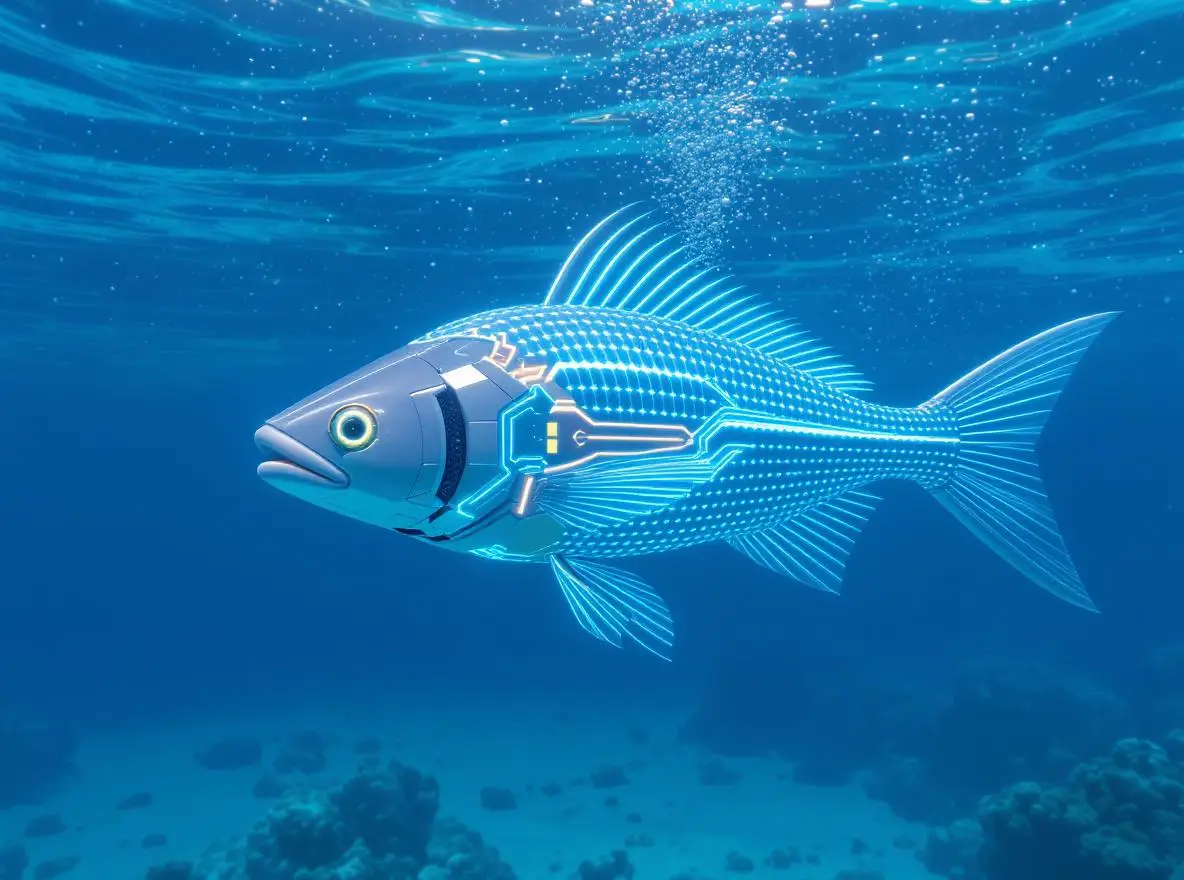
From Nature to New Tech
For millions of years, fish have relied on a built-in superpower — the lateral line — to sense ripples, vibrations, and sounds in the water. This natural sensor is so precise that it helps them detect predators, find prey, and move safely in dark or murky conditions.
Now, researchers have taken inspiration from this ability. They have built a biomimetic optical fiber neuromast (BOFN) — a very small, 3D-printed sensor that works like a fish’s lateral line but can do even more.
How the Sensor Works
The BOFN combines optical fibers with a tiny, 3D-printed hair-like cilium and a support cell. Together, they turn changes in water movement into light signals that can be measured.
When water flows or a sound wave passes by, the cilium bends slightly. This bending changes how light bounces inside a small cavity in the sensor. As a result, the sensor can detect speed, direction, and pressure changes in the water. In addition, it can pick up ultrasonic signals, which means it can “hear” underwater.
Why It’s a Breakthrough
First, it’s extremely sensitive. The BOFN can detect sound at 172.24 V/kPa and measure turbulence as small as a few micrometers per second.
Second, it’s multi-purpose. Unlike many other underwater sensors, it can measure sound, vibration, and water flow using just one device.
Third, it’s tiny and tough. Built directly onto the tip of an optical fiber, it’s thinner than a human hair but strong enough to work in harsh marine environments.
Because of these features, it can even read Morse code signals in the water. This makes it possible for quiet, hidden communication between underwater vehicles. Furthermore, when installed in a robotic fish, the sensor allows it to map surroundings, track objects, and monitor environmental changes in real time.
Where This Could Be Used
Thanks to its size and accuracy, this technology could be a game changer in several areas:
- Marine Exploration – Create detailed underwater maps without bulky sonar.
- Environmental Protection – Track ocean currents, pollution spread, or animal movements.
- Naval Security – Detect submarines or underwater drones without making noise.
- Rescue Operations – Send emergency signals in deep water without radio.
With its ability to merge nature’s design with high-tech engineering, the BOFN could help us explore and protect the oceans in ways that were impossible before.
Check out the cool NewsWade YouTube video about this article!
Article derived from: Li, L., Fan, X., Chen, G. et al. From fish to fiber: 3D-nanoprinted optical neuromast for multi-integrated underwater detection. Nat Commun 16, 7390 (2025). https://doi.org/10.1038/s41467-025-62559-3