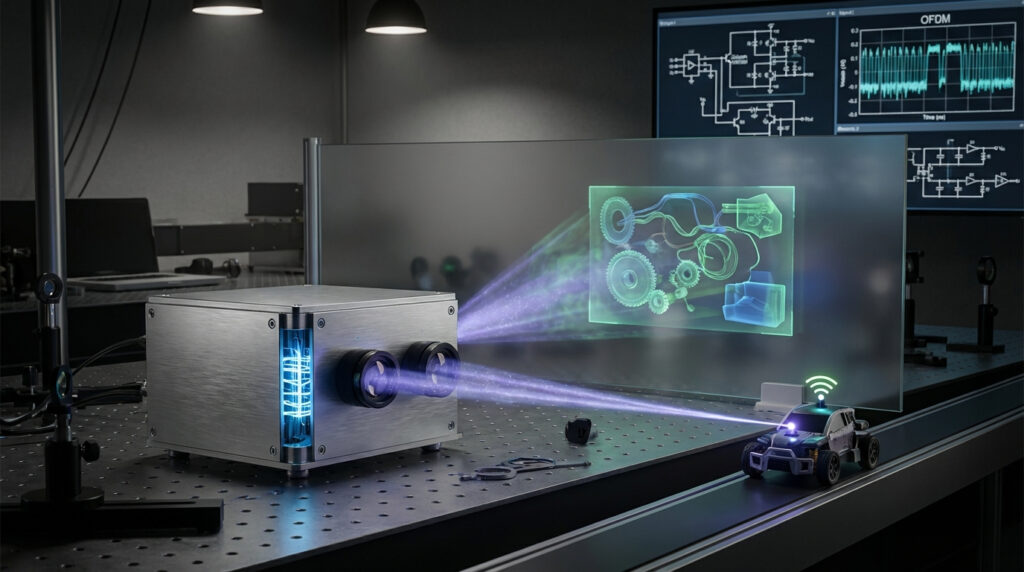


As traditional silicon chips push their limits, researchers are finding smarter ways to compute—using light instead of electricity. In a new study, scientists have created an ultra-fast, low-power all-optical XOR logic gate. This breakthrough combines photonic crystals with artificial intelligence to unlock new potential for faster and more energy-efficient computing.
Published in Scientific Reports (2025), the research introduces a two-dimensional photonic crystal (2D PC) structure, optimized using a clever mix of artificial neural networks (ANN) and particle swarm optimization (PSO). This compact logic gate may play a key role in building the next generation of optical computers.
Why Do Optical Logic Gates Matter?
Logic gates are the core of every digital system. The XOR (exclusive OR) gate, in particular, helps with critical operations like binary addition, encryption, and data comparison. Traditionally, logic gates rely on electric current flowing through silicon transistors. But as these systems shrink, they become harder to manage, and power efficiency drops.
That’s where optical logic gates come in. Instead of using electricity, they use light—specifically, photons—to carry information. These gates can perform faster, generate less heat, and allow for multiple light signals to pass through different paths at the same time.
The Role of Photonic Crystals
To control light, engineers use photonic crystals. These are tiny structures with a repeating pattern of materials that affect how light moves through them. Think of them as semiconductors for photons. By changing the layout of the crystal, scientists can control which wavelengths pass through and which get blocked.
In this study, the team used gallium arsenide (GaAs) rods arranged in a 15×15 square grid. They designed the layout to work at 1.55 micrometers, a standard wavelength in fiber-optic communication.
How Artificial Intelligence Improves the Design
Designing these gates is not easy. Small changes in size or spacing can ruin performance. To solve this, the researchers trained an artificial neural network (ANN) on 555 simulation results from the Finite-Difference Time-Domain (FDTD) method. This AI model quickly learned how the gate’s design affected its output.
Once the ANN understood the patterns, the team used particle swarm optimization (PSO) to fine-tune the layout. PSO mimics the way birds or fish move in groups. Each solution—called a “particle”—flies through the search space to find the best result. Together, these particles help find the optimal shape and size for the photonic crystal.
What Did the Final Design Achieve?
The optimized design performed impressively well. It produced the following outputs:
- Logic 0 → 0.015 (very low light)
- Logic 1 → 0.995 and 0.935 (very high light)
- Contrast Ratio (CR) → 17.947 dB
These numbers show that the gate cleanly separates logical 1s from 0s, which is critical for reliable computing.
Why This Discovery Matters
This all-optical XOR gate brings several major advantages:
- Speed: Light moves faster than electricity, boosting performance.
- Efficiency: Optical systems waste less energy and generate less heat.
- Compactness: The 15×15 grid fits easily into future optical chips.
- AI-powered precision: ANN and PSO make the design process faster and more accurate.
The best part? The structure avoids complex features like loops or nonlinear materials. It’s simple, symmetrical, and easier to build with existing nanofabrication tools.
Looking Ahead
This research shows that combining AI with photonic design isn’t just possible—it’s powerful. While the team notes that real-world manufacturing may require slight adjustments to the sizes, their approach still offers a huge leap forward in speed and efficiency.
As we head into a future filled with quantum computing, AI, and big data, smart designs like this one could replace outdated, power-hungry hardware. Photonic circuits may soon become the backbone of ultra-fast processors, especially in telecom, defense, and advanced AI systems.
Check out the cool NewsWade YouTube video about this post!
Article derived from: Heidari, F., Pashabadi, D., Fathi, M. et al. Optical XOR logic gate design in two dimensional photonic crystal using ANN and PSO. Sci Rep 15, 26471 (2025). https://doi.org/10.1038/s41598-025-12146-9