
Reconstructing Time: Synthetic Cells with Working Biological Clocks
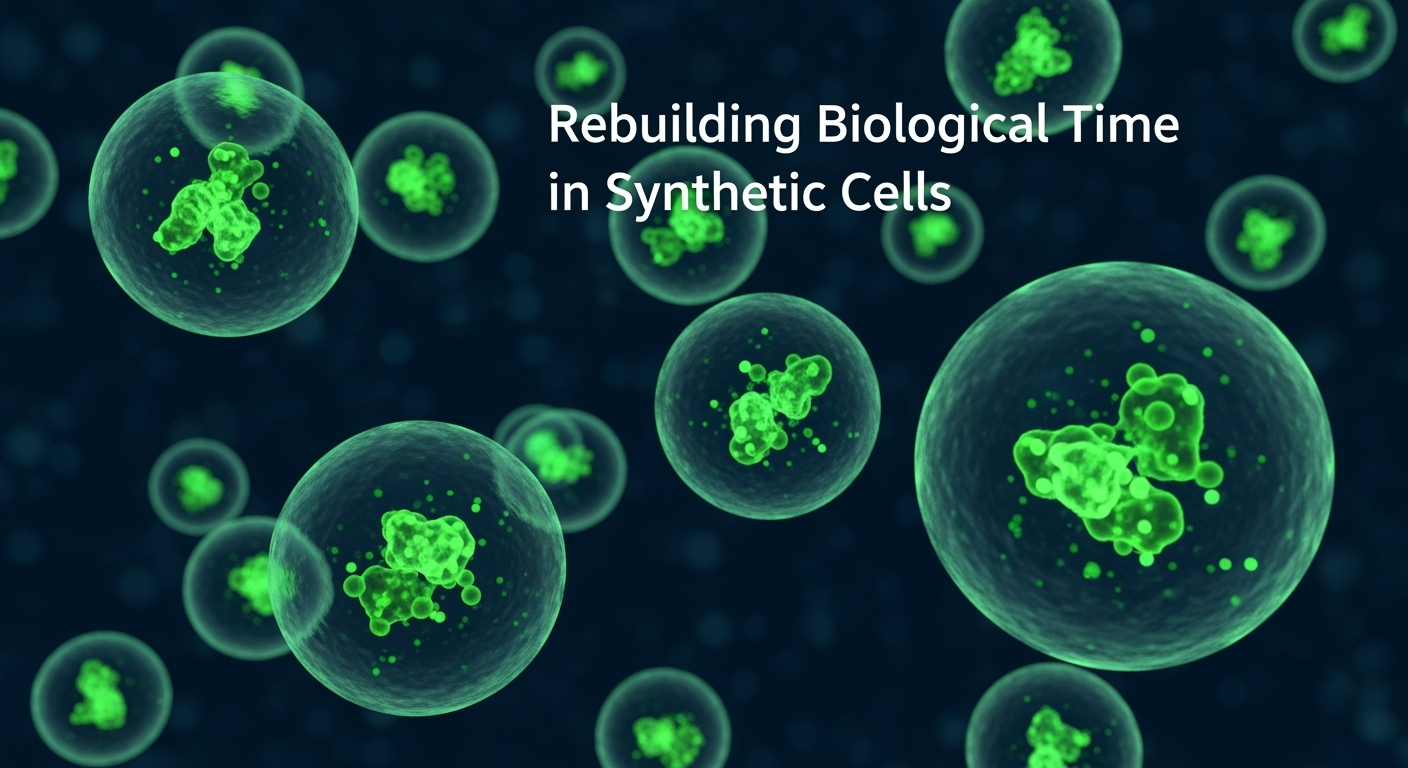
In a landmark study published in Nature Communications (July 2025), researchers have successfully reconstituted the cyanobacterial circadian clock inside artificial cells. This achievement goes beyond just tinkering with biological parts—it reveals core principles of how living cells keep time with stunning accuracy, even in volumes as small as a few femtoliters.
This study, led by Alexander Zhan, Tu Li, Andy LiWang, and Anand Bala Subramaniam, represents a major step forward in synthetic biology, demonstrating how minimal systems can replicate complex biological rhythms. At the heart of the experiment is a synthetic setup using giant unilamellar vesicles (GUVs)—tiny bubble-like containers that mimic living cells.
Why Cyanobacteria?
Cyanobacteria are single-celled organisms that photosynthesize and possess one of the simplest, yet most robust, circadian clocks known to science. Despite having no nervous system and extremely small volumes (~2 femtoliters), they maintain precise 24-hour rhythms. How?
They rely on a core trio of proteins—KaiA, KaiB, and KaiC—which operate through a post-translational oscillator (PTO). Unlike most eukaryotic clocks that rely heavily on DNA transcription and translation feedback loops, the PTO in cyanobacteria can tick all on its own, even outside the cell.
Engineering a Synthetic Clock
Using a technique called PAPYRUS with diffusive loading, the research team encapsulated purified Kai proteins into GUVs. These synthetic cells then underwent long-term confocal imaging, allowing the researchers to monitor fluorescently labeled KaiB proteins and observe oscillations.
The result? Many of these synthetic cells showed autonomous circadian rhythms similar to those in living cyanobacteria. But not all oscillated—so what made the difference?
The Secret to Precision: Concentration, Size, and Support Proteins
The study introduced a new metric: clock fidelity, defined as the percentage of synthetic cells showing proper oscillation. Key insights include:
- Fidelity increased with protein concentration: High concentrations of KaiA, KaiB, and KaiC were essential to overcome random fluctuations inside tiny vesicles.
- Larger vesicles were more reliable: Smaller GUVs showed more variability and lower fidelity.
- Membrane effects matter: KaiB proteins tended to stick to the vesicle membranes, reducing their availability for clock function.
- Accessory proteins are crucial: Adding CikA and SasA—proteins known to buffer variations in the natural system—significantly improved clock function and matched real biological behavior.
Synchrony Through Feedback
While the PTO alone was enough for individual clocks to tick, synchrony across a population required the transcription-translation feedback loop (TTFL). Mathematical modeling revealed that without TTFL correction, individual clocks slowly drifted out of sync due to minor period variations. Adding the TTFL restored the phase coherence seen in natural cyanobacteria.
Why This Matters
This study isn’t just a technical feat—it provides a template for building life-like systems from the bottom up. Understanding how to replicate robust, synchronized biological clocks could:
- Advance synthetic biology by enabling autonomous timekeeping in artificial cells
- Improve biomanufacturing systems that require rhythmic control of gene expression
- Shed light on human circadian disorders by offering minimalist models to study clock dysfunction
Moreover, the ability to simulate biological complexity using minimal components opens the door to a new era in programmable biology, where artificial cells could coordinate tasks, adapt to environments, and even operate in sync with real biological systems.
Final Thoughts
The reconstitution of the cyanobacterial circadian clock in synthetic cells is a masterclass in blending biology, physics, and engineering. It reminds us that nature’s most elegant systems often emerge from simple rules—carefully balanced and finely tuned. Now that we understand how bacteria keep time, we may be one step closer to designing synthetic life that runs like clockwork.
Check out the cool NewsWade YouTube video about this post!
Article derived from: Li, A.Z.T., LiWang, A. & Subramaniam, A.B. Reconstitution of circadian clock in synthetic cells reveals principles of timekeeping. Nat Commun 16, 6686 (2025). https://doi.org/10.1038/s41467-025-61844-5