
What happens when you take a single particle of light—a photon—and give it a twist? Does it spin forever? Or does quantum physics throw us a curveball?
A team of physicists from Finland and Germany answered this question in the coolest way imaginable. They proved that even a single photon conserves orbital angular momentum (OAM)—its “twist.” That means nature plays fair, even at the tiniest quantum scale.
This isn’t just a physics victory—it’s a major leap forward in developing the next generation of quantum technologies.
Light Doesn’t Just Shine. It Spins.
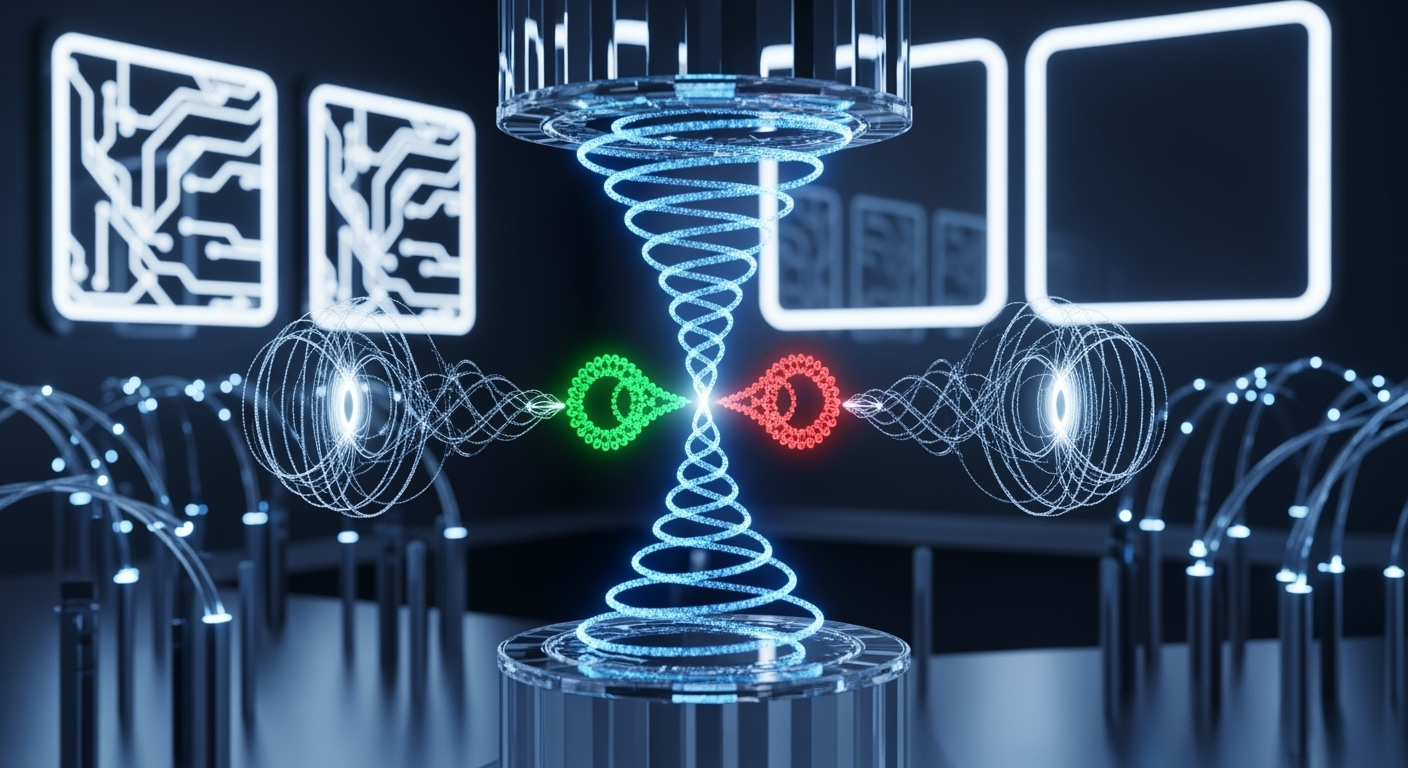
We usually think of light as something that shines. But photons can also spin, not like a top, but in a spiral wave pattern. This spin is called orbital angular momentum (OAM). Imagine a beam of light corkscrewing through space—it looks pretty, but it also carries real angular momentum.
When a high-energy photon travels through a special crystal, it can split into two lower-energy photons. This process, called spontaneous parametric down-conversion (SPDC), must obey the rule of OAM conservation. That means the “twist” in the original photon must equal the sum of twists in the two new photons.
The Quantum Leap: One Photon Is Enough
Before this study, scientists could only test this idea using lasers filled with trillions of photons. That’s like watching the wave in a stadium—you see the pattern, but not the individual actions.
This team took a bold step and used a single photon to power the experiment. They created a system that split a photon in one crystal, then used that photon to trigger another split in a second crystal.
And it worked.
Even when using just one photon as the pump, the two resulting photons followed the rule: the total angular momentum stayed the same.
How They Pulled It Off
The researchers designed a clever two-crystal setup:
- First crystal: They used SPDC to generate a pair of photons. One acted as the pump for the next step, while the other served as a “herald” to confirm the photon’s existence.
- Second crystal: They sent the single photon into another SPDC process to produce two more photons.
They shaped the incoming light’s twist using a device called a spatial light modulator and measured the twist of the outgoing photons using high-precision detectors.
In every case—even when they adjusted the incoming photon to have different twist values (like ℓ = –1 or +2)—the results matched the rule. The two output photons added up perfectly to the twist of the input photon.
Why This Matters for Everyone
This isn’t just academic. Controlling the twist of photons allows engineers to:
- Build quantum encryption systems that are virtually unbreakable
- Create quantum computers that process information in new ways
- Develop super-resolution imaging tools that can see inside living tissues or through clouds and fog
By confirming that single photons follow the rules of angular momentum, researchers have strengthened the foundation of quantum optics—and opened the door to new tech breakthroughs.
The Future: More Twists to Come
Imagine sending a message encoded not in 1s and 0s—but in the twist patterns of light. This work pushes us closer to high-dimensional quantum communication using OAM.
Although the experiment used bulky crystals and took dozens of hours to collect enough data, future systems could use better crystals, faster detectors, and more efficient photon shapers to scale things up.
This isn’t just spinning light—it’s spinning toward the future.
Check out the cool NewsWade YouTube video about this article!
Article derived from: Phys. Rev. Lett. 134, 203601 – Published 20 May, 2025 DOI: https://doi.org/10.1103/PhysRevLett.134.203601