
A New Era for Micro-Grippers
Micro-grippers are essential in fields like electronics, medicine, and micro-robotics. They help handle tiny parts in chip manufacturing and perform delicate tasks like cell manipulation. But many current designs fall short in stroke length or gripping accuracy.
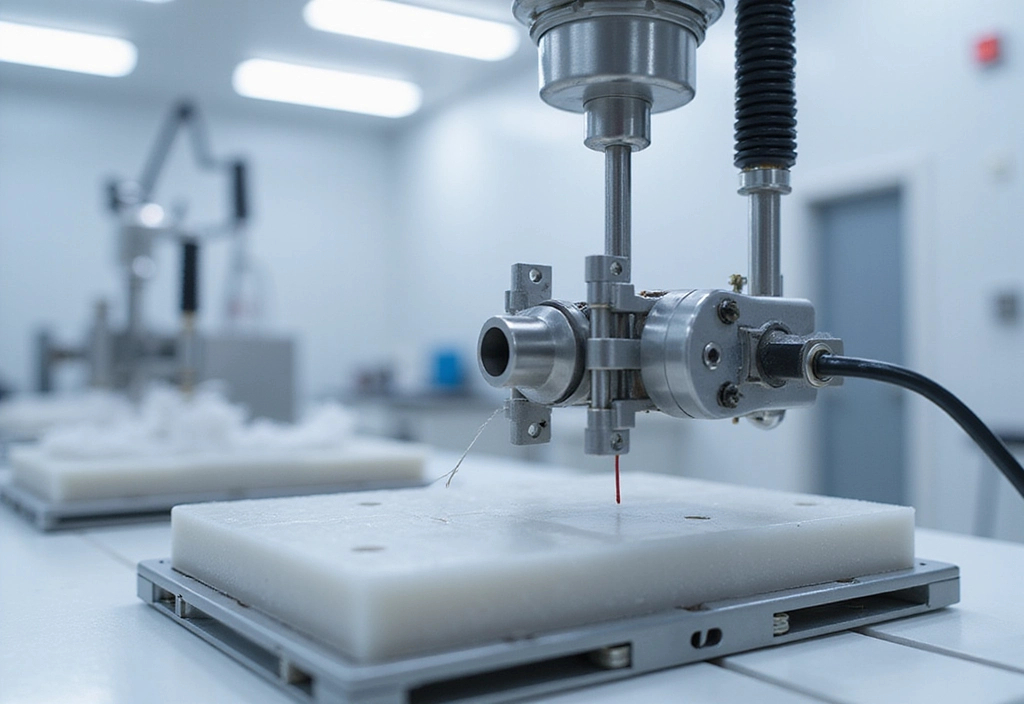
This problem inspired a team from Tianjin to build something new — a micro-gripper with a flexible four-bar mechanism. Their invention offers a long stroke, high resolution, and smooth control. It’s small in size but big in performance.
The Challenge with Traditional Micro-Grippers
Most micro-grippers rely on piezoelectric actuators. These actuators are fast and precise but have a small displacement range — often just a few micrometers. To increase their output, engineers add mechanical amplifiers like levers or bridge structures.
These solutions work, but they often come with trade-offs. They can be bulky or limited in motion range. That’s where the four-bar flexure design shines.
What Makes the Four-Bar Flexure Design Special?
This design uses flexure hinges instead of traditional joints. These hinges bend slightly under force and return to their original shape. They’re perfect for tiny, precise movements.
When a small input from a piezoelectric actuator is applied, the four-bar linkage multiplies it. In this design, a ~18 μm input becomes an impressive 880 μm gripping range — over 40 times the original motion.
Validated by Simulations and Experiments
The team used ANSYS 2025 software to test their design. Simulations showed the predicted amplification held true. The flexure mechanism stayed within safe stress limits, and the motion matched theoretical values.
Experiments backed it up. Using a high-tech lab setup, researchers recorded the gripper’s performance with sensors. The resolution was just 50 nanometers, and force errors were under 2 millinewtons.
Force and Displacement Under Full Control
What sets this system apart is its dual control mode. It can switch between:
- Displacement control, for positioning
- Force control, for gentle gripping
This switch happens smoothly and in real-time. For example, it can grip a 400 μm plastic tube with just the right amount of force, then release it precisely. The system responds to sensor feedback and adjusts accordingly.
Practical and Powerful
Despite its precision, the micro-gripper is compact. It’s built with standard parts like piezo actuators and springs. That means it’s easier and cheaper to make than other complex systems.
This design could be a game changer in:
- Chip packaging and micro-assembly
- Biomedical tools like cell injection systems
- Flexible robots for lab-on-chip devices
Final Thoughts
This micro-gripper proves that big things can come in small, smart packages. With its powerful amplification, high accuracy, and simple control, it could reshape how we work at the micro and nano scales.
Researchers have shown that mechanical systems, when cleverly redesigned, can still surprise us. The four-bar flexure gripper is proof of that.
Article derived from: Cui, L., Zhu, H., Deng, X., & Chai, Y. (2025). Design and Implementation of Flexible Four-Bar-Mechanism-Based Long-Stroke Micro-Gripper. Actuators, 14(7), 338. https://doi.org/10.3390/act14070338