
Imagine a robot that can feel damage, heal itself like human skin, and return to full functionality — all without needing a technician. Thanks to breakthrough research at the University of Nebraska–Lincoln, that future is getting much closer.
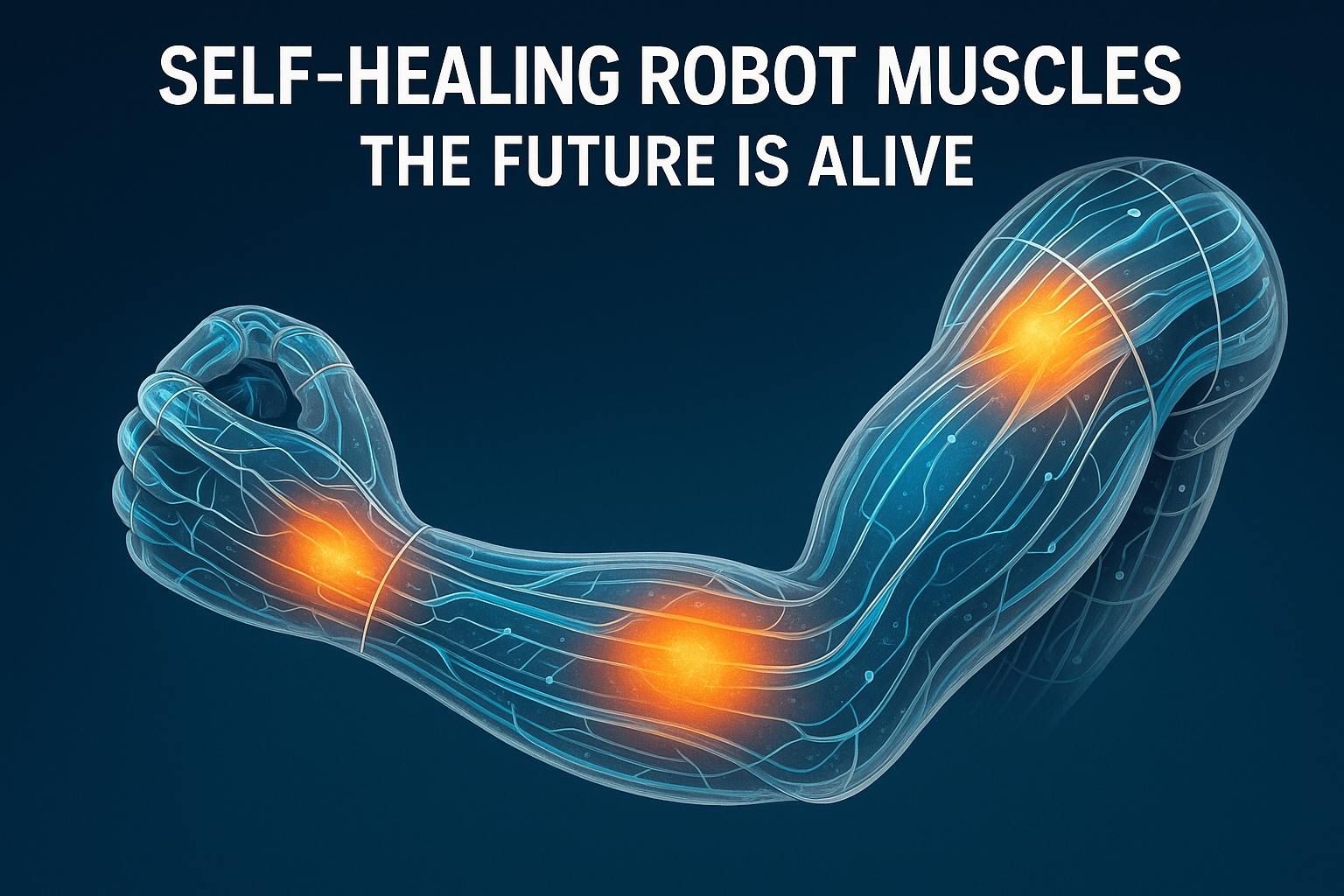
A team of Husker engineers has developed an artificial muscle actuator that doesn’t just perform motion — it also thinks about its own well-being. Designed for soft robotics, this new actuator is equipped with a smart, multilayered design that mimics biological tissues in an entirely synthetic system.
A Smart Design That Repairs Itself
The team’s actuator consists of three highly engineered layers:
- Bottom layer (sensor): A silicone elastomer embedded with liquid-metal microdroplets. This layer monitors electrical paths and detects damage automatically.
- Middle layer (healing): A thermoplastic elastomer that melts and reseals itself when heated, like synthetic muscle regenerating tissue.
- Top layer (actuation): A pressurized channel filled with water, allowing the device to bend and move like real muscle.
When damage occurs — say, from puncture or pressure — the system doesn’t need external help. The bottom layer detects irregular electrical signals caused by the damage. This triggers Joule heating, which melts the elastomer in the middle layer and seals the wound. Then, using electromigration, the conductive network in the sensor layer resets itself by moving metal particles back into position.
The result? A completely autonomous sense-heal-reset cycle — the kind of closed-loop resilience living systems display.
Why It Matters
This kind of built-in intelligence means these artificial muscles don’t just move — they survive. In harsh, unpredictable environments where real-world robotics operate (think: agriculture, health wearables, space tech, disaster zones), durability is just as important as function.
The implications are massive:
- Soft robots that keep working even when damaged
- Wearables that self-repair without users noticing
- Eco-friendly electronics with longer life spans
- Military or space bots that fix themselves in real-time
And the tech is already earning praise. The team’s work, led by assistant professor Eric Markvicka, was named a Best Paper Award finalist at the 2025 IEEE International Conference on Robotics and Automation (ICRA) — selected from more than 1,600 entries.
What’s Next?
The Husker team is already exploring how to scale up this innovation and integrate it into more advanced robotic systems. They’re also looking into ways to fine-tune the self-healing process, making it faster, more efficient, and even smarter.
While today’s robots mostly rely on human maintenance, Nebraska’s self-healing actuator is paving the way for a new kind of intelligent machine — one that doesn’t just perform, but survives.
Check out the cool NewsWade YouTube video about this article!
Article derived from: Husker engineers advance work on intelligent, self-healing technology | Nebraska Today. (n.d.). https://news.unl.edu/article/husker-engineers-advance-work-on-intelligent-self-healing-technology