
What Is This All About?
Concrete is everywhere—from bridges and buildings to tunnels and roads. But what happens when it fails?
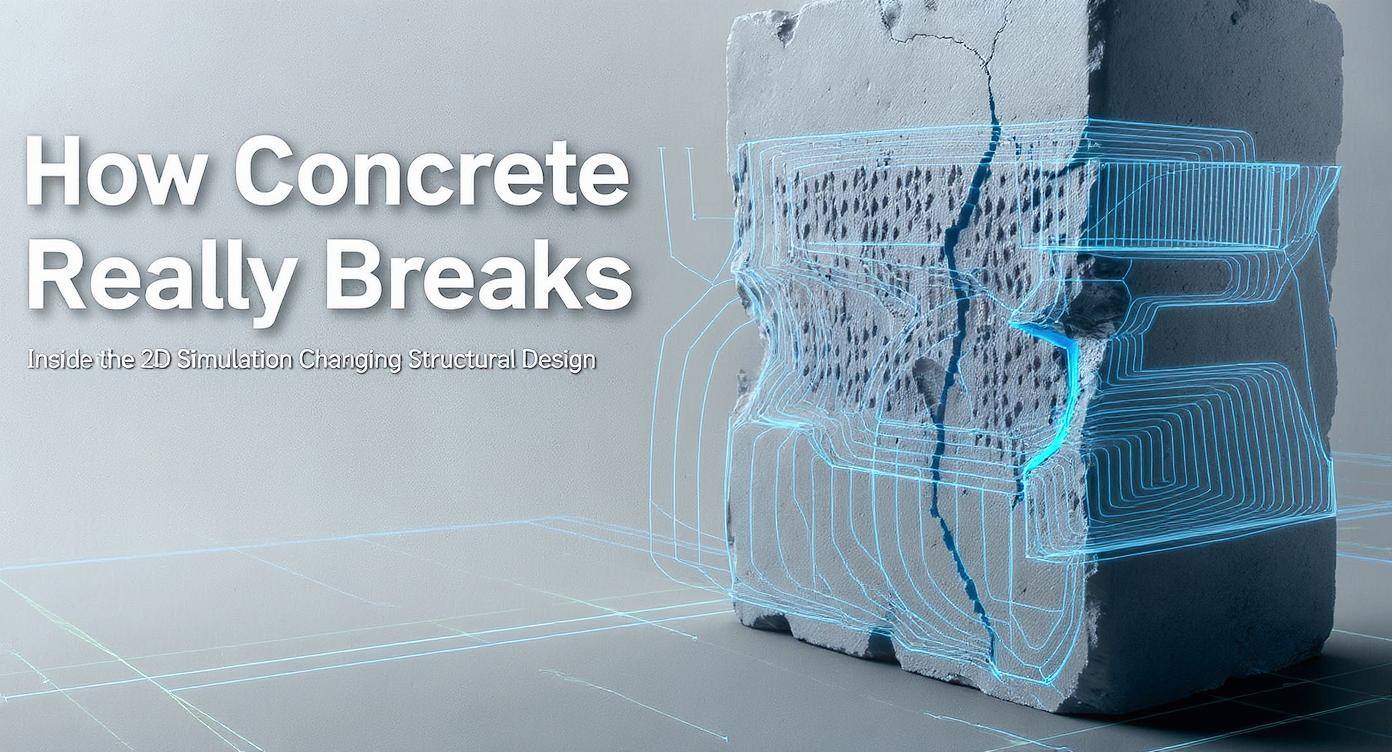
Scientists from Finland have built a detailed digital model that shows how concrete actually fractures when it’s stretched, squeezed, or hit hard. It’s not just theory—it’s a powerful tool that could make the built world safer.
A Closer Look at Concrete’s Hidden Structure
Concrete isn’t one solid material. It’s a mix of hard stones (called aggregates), softer mortar, and weak zones between the two known as the interfacial transition zones (ITZ). These zones are where cracks love to start.
This 2D model captures that complexity. It doesn’t treat concrete as a uniform block. Instead, it includes each layer and material difference. That allows scientists to see how cracks begin, spread, and interact with internal features.
How Does the Simulation Work?
The team used a method called finite element analysis. It slices the digital concrete into thousands of tiny triangles. Each triangle responds to forces based on its material type—rock, mortar, or weak interface.
They then applied different types of stress, like pulling or squeezing. They even simulated a real-world experiment known as the Brazilian Disc Test, where a round piece of concrete is compressed from opposite sides until it splits.
Surprising Discoveries from the Digital Lab
One of the biggest surprises? Even when the material properties stay the same, different arrangements of the rocks can completely change how the concrete breaks.
In some cases, cracks followed expected paths. In others, they split in unpredictable ways—just because of how the aggregates were randomly placed. That’s a big deal. It shows that mix design isn’t just about strength, but also about how a structure might fail.
Why Speed Matters: Strain Rate Sensitivity
The researchers also tested how speed of loading affects concrete. When hit quickly—like during an earthquake or explosion—concrete behaves differently.
At higher loading speeds, it becomes stronger but more brittle. That means it can resist more force, but when it does crack, it does so violently. This insight is critical for designing structures that face dynamic loads, such as dams, tunnels, or blast-resistant buildings.
The Future: From 2D to 3D Simulations
Right now, the model is two-dimensional. It looks at a flat slice of concrete. While that’s useful, real concrete is, of course, three-dimensional. The team is already working on a 3D version that can offer even more accurate predictions for real-world structures.
Real-World Benefits for Safety and Design
This simulation isn’t just academic. It can help engineers:
- Design stronger, more reliable concrete mixes
- Predict how buildings will behave under extreme stress
- Reduce costs by catching design flaws before construction begins
- Improve safety for infrastructure in earthquake zones or high-impact environments
Final Thoughts
Concrete might look simple, but it’s full of surprises. This new 2D fracture model shows that even small differences inside the material can lead to big changes in how it breaks. With tools like this, we’re one step closer to smarter cities and safer structures.
Check out the cool NewsWade YouTube video about this article!
Article derived from: Saksala, T., Dhakal, S., & Kouhia, R. (2025). A 2D mesoscale model for concrete fracture under dynamic loading. Rakenteiden Mekaniikka (Journal of Structural Mechanics), 58(1), 1–15. https://doi.org/10.23998/rm.148803