
Why Study Solar Neutrinos?
Solar neutrinos help scientists probe the Sun’s core. They are produced during nuclear reactions and escape the Sun almost instantly. These tiny particles carry valuable information about the conditions deep inside our star.
One of the most important reactions in this context is the N(p,γ)O reaction. It controls the pace of the CNO cycle, a key process in stellar fusion. But at solar energies, the cross section for this reaction is too small to measure directly—until now.
What Is the SOCIAL Project?
The SOCIAL project (SOlar Composition Investigated At LUNA) is designed to solve this problem. Located deep underground at Italy’s Gran Sasso National Laboratory, it uses cutting-edge technology to measure the N(p,γ)O cross section with just 5% uncertainty.
Why is this important? Because current solar models rely on estimated data. Better measurements mean more accurate predictions of neutrino production and, by extension, solar composition.
The Big Challenge
At solar energies (around 28 keV), the reaction becomes incredibly rare. Past experiments only reached down to 70 keV. This made extrapolation necessary—and introduced significant uncertainty.
Moreover, measuring the ground-state transition of the reaction is particularly hard. It’s much weaker than the transitions to excited states and often buried in background noise. The SOCIAL project tackles this challenge head-on.
How SOCIAL Improves Measurement Precision
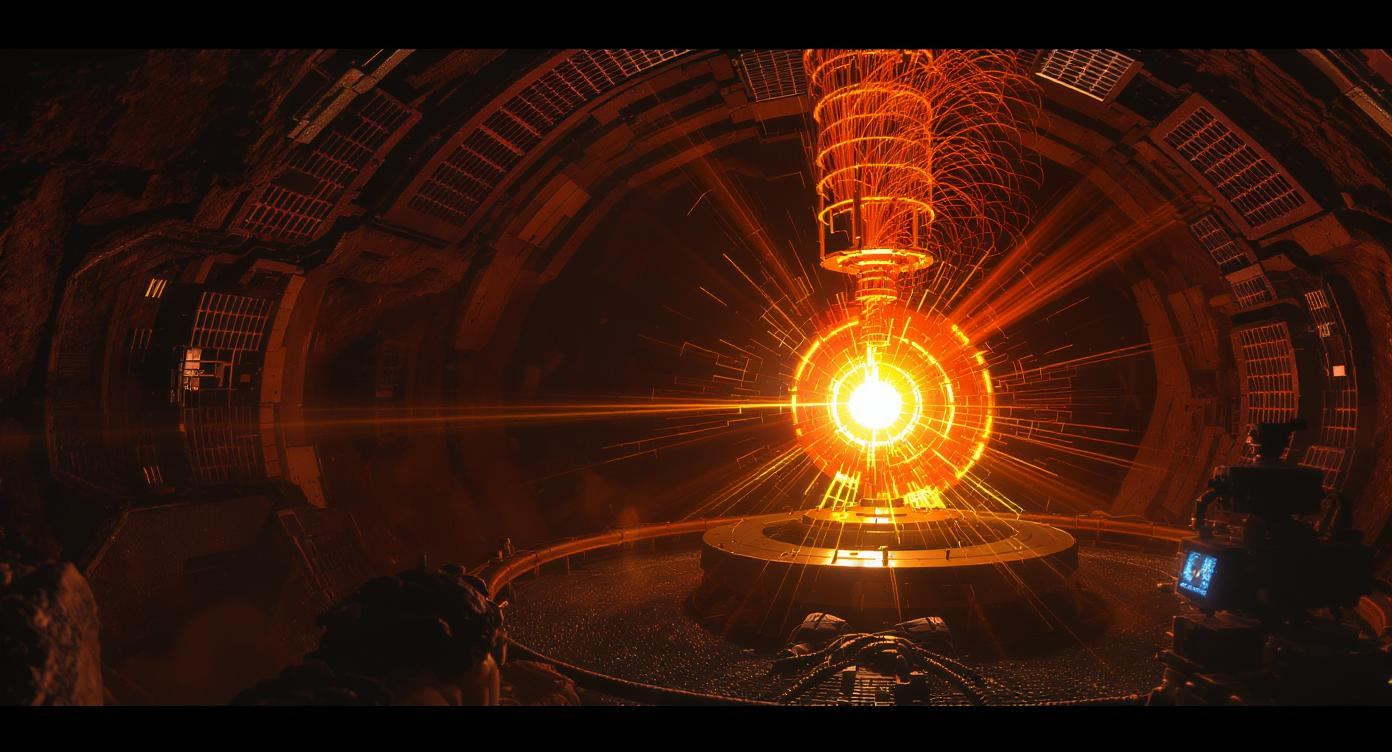
SOCIAL uses the LUNA-400 accelerator, which delivers a powerful proton beam to a solid titanium nitride (TiN) target. These reactions produce gamma rays, which are detected by a segmented BGO (Bismuth Germanate) detector.
To reduce background noise, the entire setup is shielded with thick lead and located underground. Additionally, the use of gamma-gamma coincidence detection and digital signal analysis dramatically improves the clarity of the results.
What Makes This Experiment Different?
Here’s what sets SOCIAL apart from earlier efforts:
- Segmented detectors help distinguish between gamma-ray events more accurately.
- Target degradation monitoring ensures that results stay reliable over time.
- Coincidence summing boosts the signal-to-background ratio, improving sensitivity.
- Custom TiN targets minimize unwanted background reactions from contaminants like fluorine.
Why This Matters for Science
A more precise N(p,γ)O cross section improves the accuracy of the CNO neutrino flux predicted by solar models. This directly affects:
- Estimates of solar metallicity—the amount of heavy elements in the Sun.
- The age of globular clusters, which could be older than previously thought.
- Our understanding of stellar evolution, especially in stars more massive than the Sun.
These findings could rewrite parts of astrophysics—and even tweak our cosmic timeline.
What’s Next?
Data collection is ongoing. The SOCIAL team is now refining their analysis to determine partial cross sections for individual gamma transitions. With their approach, they’re not just improving measurements—they’re changing how we study the stars.
Check out the cool NewsWade YouTube video about this article!
Article derived from: Gosta, G., Rosanna Depalo for the LUNA collaboration. The SOCIAL project: measurement of the 14N(p,γ)15O cross section. Eur. Phys. J. A61, 110 (2025). https://doi.org/10.1140/epja/s10050-025-01561-1